

Hiring a remodeling contractor is one of the largest financial decisions most San Diego homeowners make. A kitchen remodel, home addition, or whole-home renovation involves significant money, months of living disruption, and a contractor working inside your most valuable asset. The protections you put in place before work starts determine how much control you keep if something goes wrong.
This guide covers the legal, financial, and practical protections every San Diego homeowner should have in place — from verifying a contractor’s license to understanding your contract, managing payments, and knowing your rights when problems arise.
In California, residential remodeling contractors must hold a valid license issued by the Contractors State License Board (CSLB). This is not optional — it’s the law, and it’s your first line of protection.
Verify any contractor’s license at cslb.ca.gov before you agree to a meeting, let alone sign a contract. Here’s what to check:
Never hire a contractor who cannot provide their license number, who asks you to pull permits in your own name (this shifts all liability to you), or who is evasive about their insurance coverage.

California law (Business and Professions Code Section 7159) requires written contracts for home improvement projects over $500. But the legal minimum and an actually protective contract are very different things. Make sure your contract includes:
The contract should describe exactly what will be built, demolished, modified, and finished — room by room, item by item. Vague language like “kitchen remodel per plans” is insufficient. If there are drawings, they should be attached as exhibits. Any item not in the scope of work will generate a change order — and that’s when costs grow.
Understand whether you’re signing a fixed-price contract (the price doesn’t change unless you change the scope) or a time-and-materials contract (you pay for hours and materials, with less cost certainty). For most residential remodeling, a fixed-price contract with clearly defined allowances for client-selected items is the standard.
California law caps the initial deposit at 10% of the total contract price or $1,000, whichever is less — except for custom materials orders. Your payment schedule should be tied to construction milestones (permit issuance, framing complete, rough-in complete, finishes complete, punch list cleared) — not calendar dates. Never pay ahead of the work.
The contract should specify a start date and a substantial completion date. Lars backs every project with a formal on-time completion guarantee — a written commitment to the agreed schedule. If your contractor can’t or won’t commit to a completion date in writing, that’s a red flag.
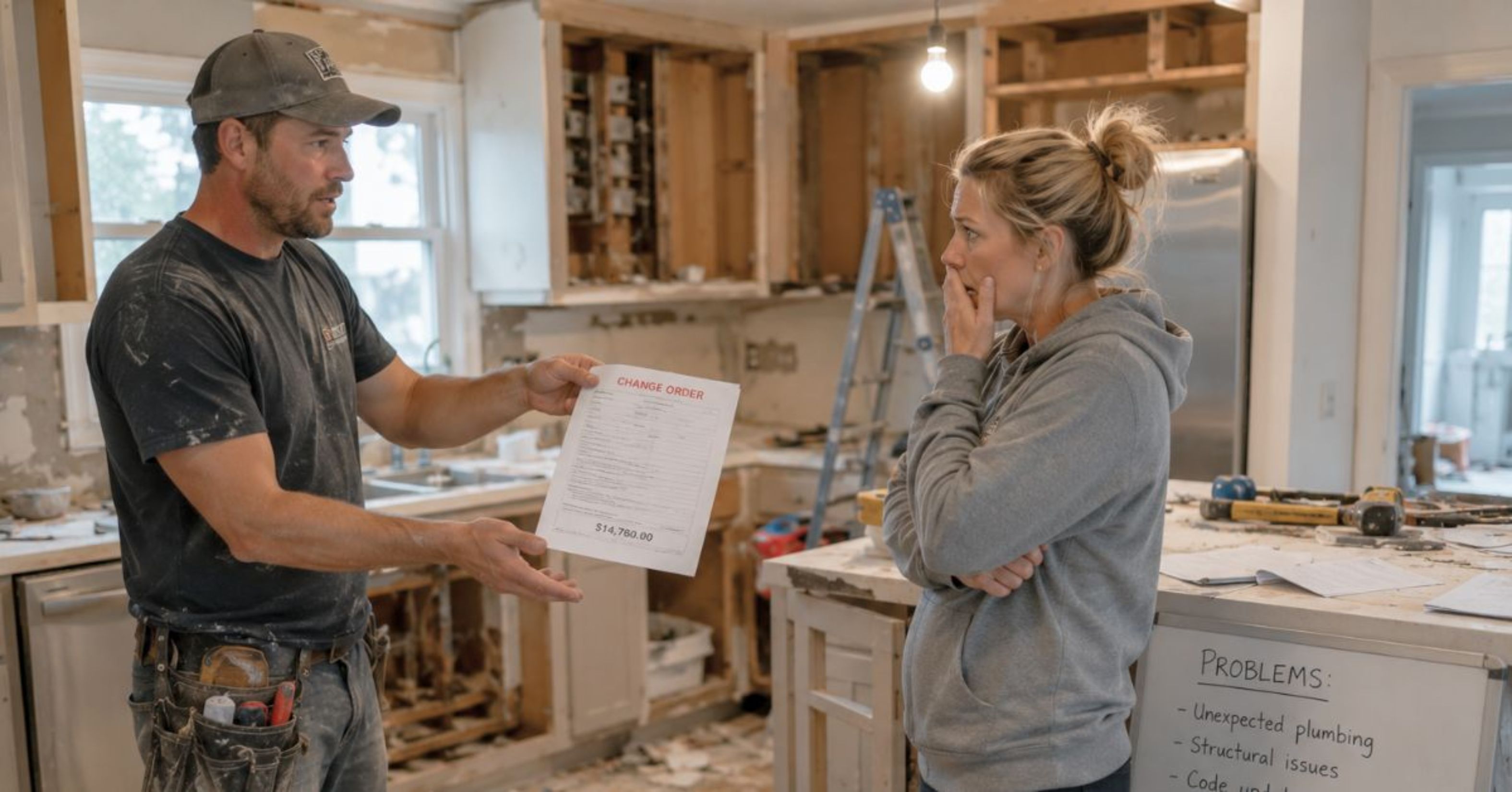
All changes to the scope of work must be documented in writing as change orders before the work is performed. A contractor who does extra work and then adds it to the final invoice without prior written authorization is in violation of California law. Your contract should define the process for requesting, approving, and pricing change orders.
At each payment milestone, require conditional lien releases from the general contractor and any subcontractors or suppliers on the job. In California, unpaid subcontractors or material suppliers can place a mechanic’s lien on your property even if you paid the general contractor in full. Lien releases confirm that downstream parties have been paid.
Most contractor problems are predictable. These are the warning signs that experienced San Diego homeowners have learned to watch for:
Financial protection doesn’t end when the contract is signed. These practices protect you through construction:
Pay by check or credit card, never cash
Every payment should be traceable. Cash payments are untraceable, create no paper record of what was paid for, and make it much harder to pursue claims if something goes wrong. Some credit cards offer additional consumer protections for disputed charges.
Keep a project file
Maintain a folder — physical or digital — with your signed contract, every change order, every payment receipt, every permit and inspection record, and all written communications with your contractor. If a dispute arises, documentation is everything.
Collect conditional lien releases with each payment
As noted above, require conditional lien releases from the general contractor and key subcontractors at each payment milestone. Your title company or real estate attorney can provide California-standard lien release forms.
Never make the final payment until punch list is complete
The final payment is your leverage. Retain it until every item on the punch list has been addressed to your satisfaction and all final inspections have passed.

California has some of the strongest homeowner protection laws in the country for construction projects:
Beyond the legal and financial protections, there are practical steps to keep your household safe while construction is underway:
Construction dust — particularly from demolition — can contain silica, lead (in pre-1978 homes), or asbestos (in pre-1980s homes). Use a high-efficiency air purifier in occupied areas, close HVAC vents near the work zone, and ask your contractor about dust containment barriers and negative air pressure setups for major demo work.
Establish clear boundaries between the construction zone and the occupied areas of your home — particularly if you have children or pets. Exposed nails, open subfloor areas, temporary wiring, and stored materials are all hazards. Your contractor should maintain a clean, organized job site at the end of each workday.
Ask your project manager how often you’ll receive formal updates and what the process is for raising concerns. A weekly written update — even a brief one — keeps you informed and creates a record of project status through all the phases of your remodel.
Many of the protection challenges described above are inherent to the traditional design-bid-build model — where multiple parties share responsibility and accountability is diffuse. In a design-build firm, one contract covers both design and construction, one team is accountable for the entire outcome, and there’s no gap between what was designed and what gets built.
This doesn’t eliminate the need for due diligence — you should still verify any firm’s license, read the contract carefully, and collect lien releases. But it eliminates an entire category of problems that arise when design and construction are siloed.
Lars’s process is built on formal commitments, not verbal promises. We pull all permits, carry full insurance, provide fixed-price contracts with detailed scope, and back every project with our on-time completion guarantee. Our warranty covers workmanship and materials beyond the project closeout.
After 35 years in San Diego, we know that homeowner trust is earned through accountability — not marketing claims.
Have questions about a remodeling contract or want to understand Lars’s process before committing? Schedule a complimentary consultation. Call 858.279.6300 or book at larsremodel.com.


What Is a Bump-Out Addition — And Is It Worth It for Your San Diego Home? You need more space, but a full room addition feels like a bigger project than you’re ready to take on. That’s where a bump-out comes in. A bump-out addition is one of the most practical, cost-effective ways to expand […]
How Much Does a Home Addition Cost in San Diego — And What’s the Cheapest Way to Add On? If your San Diego home has run out of room, you have options — but the costs range widely depending on what you build, how you build it, and who builds it. A modest bump-out that […]

Master Bedroom Remodel Guide: Layouts, Costs, and What San Diego Homeowners Are Getting Right The primary bedroom is the one room in your home that belongs entirely to you. It’s where the day starts and ends, where you retreat when the rest of the house is at full volume, and where the quality of design […]
See What Happy Clients Are Saying About Us
When you decide to remodel your home in San Diego, count on our team of experienced builders and talented home design contractors to handle every stage of the design-build process diligently and professionally. We apply a wide range of skills to transform your living space with style and precision:
We’ll discuss the length of your project during an initial consultation. Although the scope of a project will determine its length, we can provide you with an approximate estimate early on.
For more information, get in touch with our home remodeling contractors in San Diego. We’ll ask you a series of detailed questions about the upcoming home remodel, which will help us prepare a preliminary estimate.
It’s the complexity of each remodel, as well as the desired goals and needs of each client, that makes each project unique. Besides the type and size of your home improvement in San Diego, the cost of materials needed plays a key role in setting up the budget.
Feel free to give us a call if you have any questions regarding the final costs of the project and consult with our experts directly. Our home design contractors will be happy to answer all of them and provide you with a more accurate estimate.
Before adding a room addition to your San Diego property, conduct a thorough inspection of your home and clarify your objectives:
Finally, you should know who to turn to for advanced assistance. Luckily, there’s a reputable local company serving San Diego communities. We at Lars Remodeling & Design would be happy to offer a detailed outline of the key aspects of your project.
For substantial additions or major renovations, it might be a good idea to think about staying somewhere else. To stick to your budget, you could stay with friends or family, or rent a place nearby so you can easily keep an eye on the remodeling progress. As experienced remodeling contractors, we’re eager to learn more about your project and explore all your options with you. Don’t hesitate to give us a call!
Absolutely. However, the value of such a renovation largely depends on factors like the property’s location, the extent of work required, and the current market conditions. For any home design or design-build project, it’s advisable to consult directly with our experienced contractors. We’ll access your San Diego residence to identify the type of remodel that would offer you the best return on investment.