Wood Bathroom Ideas: Why Wood Works in the Bathroom (and Where It Doesn’t)
01.

- Share this article
-

-

-

-

-

-

By TJ Kidder, Lars Remodeling & Design · Sources checked October 20, 2026
Yes, wood works in a bathroom, including a coastal San Diego bathroom. No species is waterproof, so the goal is a stable, decay-resistant material that is sealed on every face, kept out of the shower’s waterproofing, and paired with a fan that clears the steam. Get those four things right and a wooden vanity, ceiling or accent wall can look good for decades.
Most bathrooms lean on white tile, porcelain and glass. They clean easily, but the room can feel cold. Natural grain adds warmth and coziness that tile can’t, which is why designers keep reaching for it. In the National Kitchen & Bath Association’s 2026 Bath Trends report, 62% of the industry pros surveyed expected wood-faced vanities to be popular, compared with 53% for painted ones.
Key takeaways
- Teak, rift- or quarter-sawn white oak and thermally modified ash handle bathroom humidity well.
- Seal all six sides of every piece, especially end grain and sink cutouts.
- Size the exhaust fan to the room and run it about 20 minutes after each use.
- Use it for vanities, ceilings, shelves and accent walls. Keep it off shower floors and out of the wet zone.
Can you use wood in a bathroom?
You can, as long as you plan for how it behaves. Lumber is hygroscopic: it takes on and gives off moisture with the air around it, according to the USDA Forest Products Laboratory’s Wood Handbook. A finish slows that exchange but doesn’t stop it. A bathroom adds three kinds of moisture:
- Steam. A hot shower drives humidity up quickly, then it falls again. Day after day, that swelling and shrinking stresses joints and the finish.
- Splash and standing water. Liquid water gets into end grain, screw holes and finish cracks much faster than vapor does.
- Salt air. Near the coast, this is mostly a hardware problem. Simpson Strong-Tie lists ocean salt air up to 10 miles from the coast as a corrosion factor, which takes in much of San Diego.
The weather itself is gentle. Lindbergh Field’s annual mean temperature is 64.7°F (NOAA, 1991–2020 normals). The real stress comes from inside the room: daily showers, not the climate.
What is the best wood for a bathroom?
For a coastal San Diego bathroom, these are the materials we’d shortlist, from most forgiving to least.
| Material | How it handles moisture | Best uses | Cost |
|---|---|---|---|
| Teak | Very durable heartwood with natural oils; low shrinkage (2.6% radial, 5.3% tangential) | High-splash vanity parts, shelves, removable shower mats and stools | Premium |
| White oak, rift- or quarter-sawn | Very durable, but moves about twice as much as teak (5.6% radial, 10.5% tangential) | Vanities, cabinets, mirror frames, paneling | Moderate |
| Thermally modified ash or pine | Heat-and-steam treatment reduces water uptake and movement | Ceilings, wall paneling, slatted accents, cabinet fronts | Premium |
| Accoya (acetylated pine) | Very low moisture uptake and movement | Painted or clear millwork in damp spots | Premium |
| Cedar, redwood, cypress, hinoki | Naturally decay-resistant, but softer, so edges dent | Ceilings, accent boards, soaking tubs | Moderate to premium |
| Red oak, common pine, untreated MDF | Less forgiving of repeated wetting | Dry decor only | Low |
Bathroom-friendly species compared (shrinkage figures from The Wood Database)
Teak: the most forgiving choice
Teak has a long history in boatbuilding. Its natural oils shed water, and it barely moves as humidity changes, so it’s the right pick where splash is hard to avoid. Those same oils can interfere with glue and finish, so the shop should wipe the surface with a solvent first.
White oak: the best value for a vanity
Rift- and quarter-sawn boards stay flatter than flat-sawn ones, and the straight grain suits the light, natural look that’s popular now. Two cautions: finish every face, and use stainless hardware. Wet oak reacts with iron and stains dark around steel screws.
Thermally modified and acetylated options
Thermory says thermally modified boards can last 25–30+ years above ground when properly installed and maintained, and Accoya backs its acetylated pine with a 50-year above-ground warranty. Both claims are for exterior use, so read them as proof of stability rather than a bathroom guarantee. They’re a strong choice for a ceiling or wall paneling, where small gaps and cupping would show.
Solid wood or veneer?
Solid stock is ideal for face frames, door frames and edges. For broad panels, a quality veneer over plywood stays flatter than wide solid boards. That’s why many custom vanities combine the two.
How to seal and finish wood in a bathroom
Every finish trades protection against how easy it is to repair. The intervals below are planning guidance, not manufacturer schedules. Refinish based on condition.
| Finish | Protection | Good for | Inspect and refresh |
|---|---|---|---|
| Penetrating oil | Low to moderate; slows absorption | Teak accessories, a low-sheen rustic look | Every 6–12 months in splash zones |
| Waterborne polyurethane | Moderate to high; clear and low odor | White oak vanities, shelves, frames | About every 2–4 years |
| Marine varnish or tung-oil marine system | High; flexible film | Vanity tops and high-splash trim | About every 2–4 years |
| Epoxy barrier coat plus topcoat | Very high | End grain and the underside of a counter | Inspect yearly; repair breaks right away |
Bathroom finish options (intervals are planning guidance, not manufacturer schedules)
How you apply it matters more than which can you buy:
- Seal all six sides before installation, including backs, edges and the plumbing cutouts in drawers and backs.
- Saturate end grain and the sink and faucet cutouts. That’s where water gets in first.
- Respect cure times. The Waterlox MARINE system calls for a sealer plus two finish coats, 24 hours between coats, and about seven days to full cure.
- Recoat when water stops beading or the film whitens, cracks or lifts, before bare grain is exposed.
Ventilation: the other half of the plan
The finish handles splash; the fan handles steam. The Home Ventilating Institute recommends 1 CFM per square foot for bathrooms up to 100 square feet. A 70-square-foot bath needs at least 70 CFM, so an 80-CFM fan is the usual pick. Larger rooms are sized by fixture: 50 CFM each for a toilet, shower and tub, and 100 CFM for a jetted tub. Place the exhaust over or near the shower or tub, add one in an enclosed toilet room, and leave it running about 20 minutes after using the bathroom.
A fan with a humidity sensor and a timer override takes the guesswork out. Duct it outdoors, never into the attic. California’s 2025 CALGreen code, in effect since January 1, 2026, requires ENERGY STAR bathroom fans that vent outside and have humidity controls (unless the fan is part of a whole-house system) in new construction and additions that add space. Your permit scope decides what applies to a remodel. An open window helps, but near the ocean it can also let damp marine air in, so it shouldn’t be your only plan.
Wood bathroom ideas: where it works
The safest bathroom design keeps the timber decorative and lets tile, stone and a waterproof membrane manage the water. These ideas hold up well.
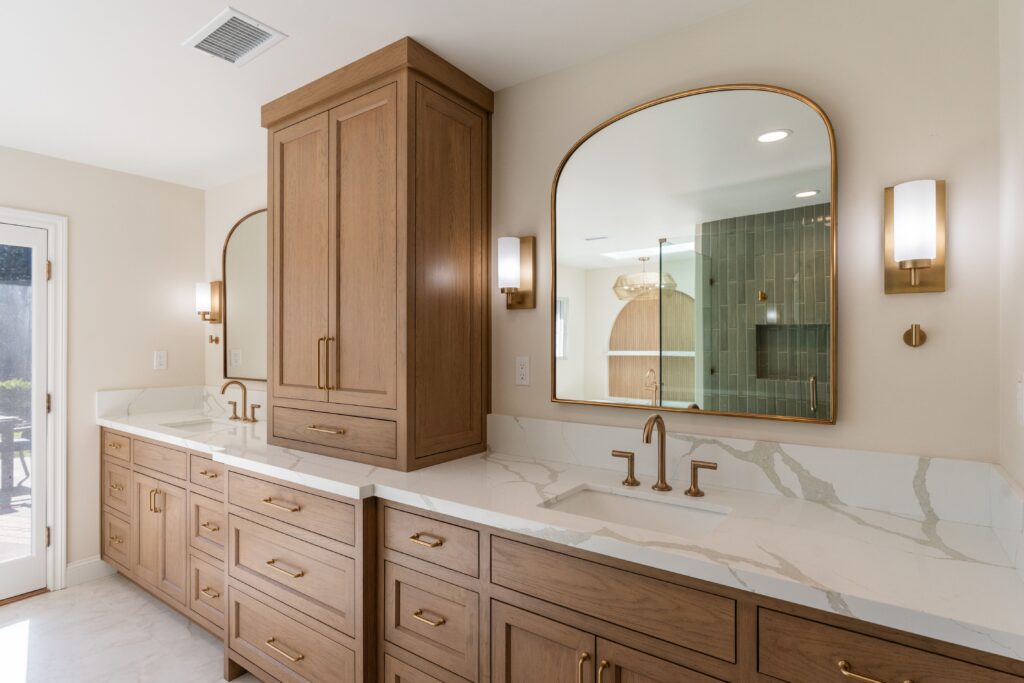
1. A wood vanity or furniture-style piece
This is the most popular place to start, as a single or double vanity. When you shop bathroom vanities, a furniture-style piece on legs or a vintage chest converted to hold a sink is a unique idea that works well if it’s stripped and refinished with a marine-grade finish. Lift the base off the floor on legs, a stone plinth or a recessed toe-kick so a tub overflow or mopping doesn’t soak the bottom edge first. Pair the cabinet with a quartz or stone top unless you’re willing to maintain a teak or epoxy-sealed counter.
2. A ceiling or beams
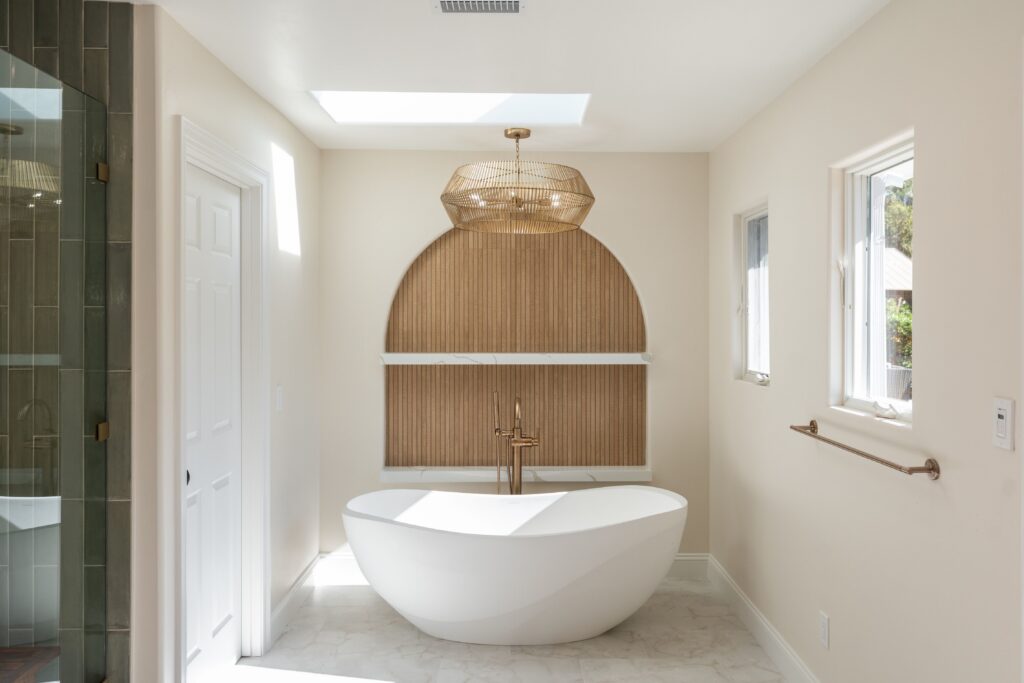
Outside the shower footprint, ceilings see vapor rather than splash, which makes them a lower-risk spot. Back-seal the boards, leave a small gap at the edges for movement, and keep exhaust airflow strong. Cedar and thermally modified boards work well. Beams can turn a high or vaulted ceiling into the room’s focal point.
3. An accent wall outside the shower
Running paneling or flooring up one wall away from the shower gives a spa feel. Mount it over a sound, dry substrate, add a small furred air gap where splash is likely, stop it above the floor, and never grout it tight to tile.
4. Floating shelves and a framed mirror
Both are easy to dry and inspect. Finish every face, use stainless supports, and leave a slight gap at the back instead of caulking the piece to the wall. Seal the bottom of a mirror frame, which collects condensation.
5. Reclaimed and barn boards
A reclaimed barn board gives a rustic look on a budget. Keep it to low-splash pieces such as a mirror frame or shelf, make sure it’s clean, dry and free of old nails, have any old paint tested for lead before sanding, and seal it completely.
6. Teak bath mats, stools and soaking tubs
Removable teak is the best way to bring natural texture near the water because you can lift it out to dry. Japanese ofuro tubs made from hinoki or cedar are a specialty piece that needs regular care.
Where wood doesn’t belong in a bathroom
- Shower floors. Standing water, soap and hidden debris make a fixed floor a poor bet. Build the floor as a sloped, fully waterproofed tile or stone assembly (see our guide to the best tile for a walk-in shower), then add a removable teak duckboard on top if you want the look.
- Inside the shower wet zone. Use tile, stone or solid surface over a continuous membrane such as Schluter KERDI, a bonded waterproofing and vapor-retarder membrane made for tiled showers.
- Steam showers. The heat and condensation are too severe. Carry the timber look outside the enclosure instead.
- Fixed benches and curbs. Build and waterproof them as part of the shower and add a freestanding teak stool.
- Baseboards at a wet floor. Use a tile or stone base for the lowest few inches, and make the vanity toe-kick removable so a future leak doesn’t ruin the cabinet.
Details that help it last near the coast
- Stainless fasteners. Simpson Strong-Tie rates Type 316 stainless for severe marine and seaside exposure, and Accoya calls for 316 in coastal sites. Don’t mix galvanized and stainless parts in one connection.
- Room to move. A flexible joint of about 1/8 inch is typical where timber meets tile or stone.
- Slope the ledges. A slight slope keeps water from pooling on a sill or shelf.
- The right glue. Titebond III passes the ANSI/HPVA Type I water-resistance test, but it isn’t rated for continuous submersion. “Waterproof” glue is not shower waterproofing.
Wooden bathroom design ideas: rustic, modern and natural styles for 2026
The NKBA’s 2026 survey also found that 80% of respondents expect large-format flooring to be most popular over the next three years, and that matte (54%) and brushed (51%) faucet finishes outpolled polished (39%). A good rule is one bold timber feature against larger, simpler tile. A designer can help you balance stain color, tile and metal finish, and the rule holds across various styles. Three styles and finishes that work:
- Light and modern. White oak in a satin waterborne finish, brushed nickel, warm-white large-format porcelain.
- Rich and contrasting. Teak in marine varnish, brushed brass, charcoal tile and an ivory wall.
- Rustic and textured. Brushed thermally modified ash or cedar with an oil finish, aged bronze and handmade-look tile.
A simple maintenance schedule
- After each shower: run the fan and wipe standing water off horizontal surfaces.
- Monthly: check sink edges, joints and bottom rails, and confirm the fan sensor works.
- Every 6–12 months: check whether water still beads, and re-oil teak accessories.
- Every 2–4 years: recoat film finishes before they crack or lift.
Frequently asked questions
What wood is best for a bathroom vanity?
Rift- or quarter-sawn white oak is the best value, teak is the most forgiving where splash is heavy, and thermally modified ash or Accoya are the most stable. Whatever you choose, finish all six sides.
Does wood get moldy in a bathroom?
Mainly if it stays damp. Mold needs moisture that lingers, so a sealed finish, a properly sized fan and wiping up standing water greatly reduce the risk. Fix any slow leak right away.
Can bathrooms have wood floors?
Solid hardwood is risky around a tub or toilet. Engineered flooring moves less but still dislikes standing water; wood-look porcelain tile gives the look with far less risk.
Can you paint a wood bathroom vanity?
Yes. Clean and sand it (test older finishes for lead first), use a bonding primer and finish with a cabinet-grade enamel. Accoya is a good substrate for painted millwork because it moves so little.
Is a wood vanity top a good idea in a small space?
It can be, but a small bath concentrates splash around the faucet. Teak or an epoxy-sealed top handles that best; for a busy master or family bath, quartz or stone on a wood base is easier to live with.
Do wooden bath mats get moldy?
A slatted teak mat that’s lifted to dry rarely does. Flat mats that sit on wet tile trap water underneath.
Planning a wood bathroom in San Diego?
To find the perfect vanity, start with how much water the spot sees, then choose the look. For inspiration, browse our remodeling gallery.
Lars Remodeling & Design has helped San Diego homeowners with bathroom design and construction for more than 35 years. If you’re considering bathroom remodeling in San Diego, our team can help you choose species, finishes and ventilation that suit your home. For budget ranges, see our San Diego bathroom remodel cost guide, or book a consultation.