San Diego ADU Regulations 2026: City and County Requirements
01.

- Share this article
-

-

-

-

-

-

San Diego ADU requirements depend on which agency governs your parcel. Inside the City of San Diego, an accessory dwelling unit may be up to 1,200 square feet with no parking space required. In the unincorporated County, the standards differ, starting with a parking requirement. Both allow up to four units on a typical single-family lot.
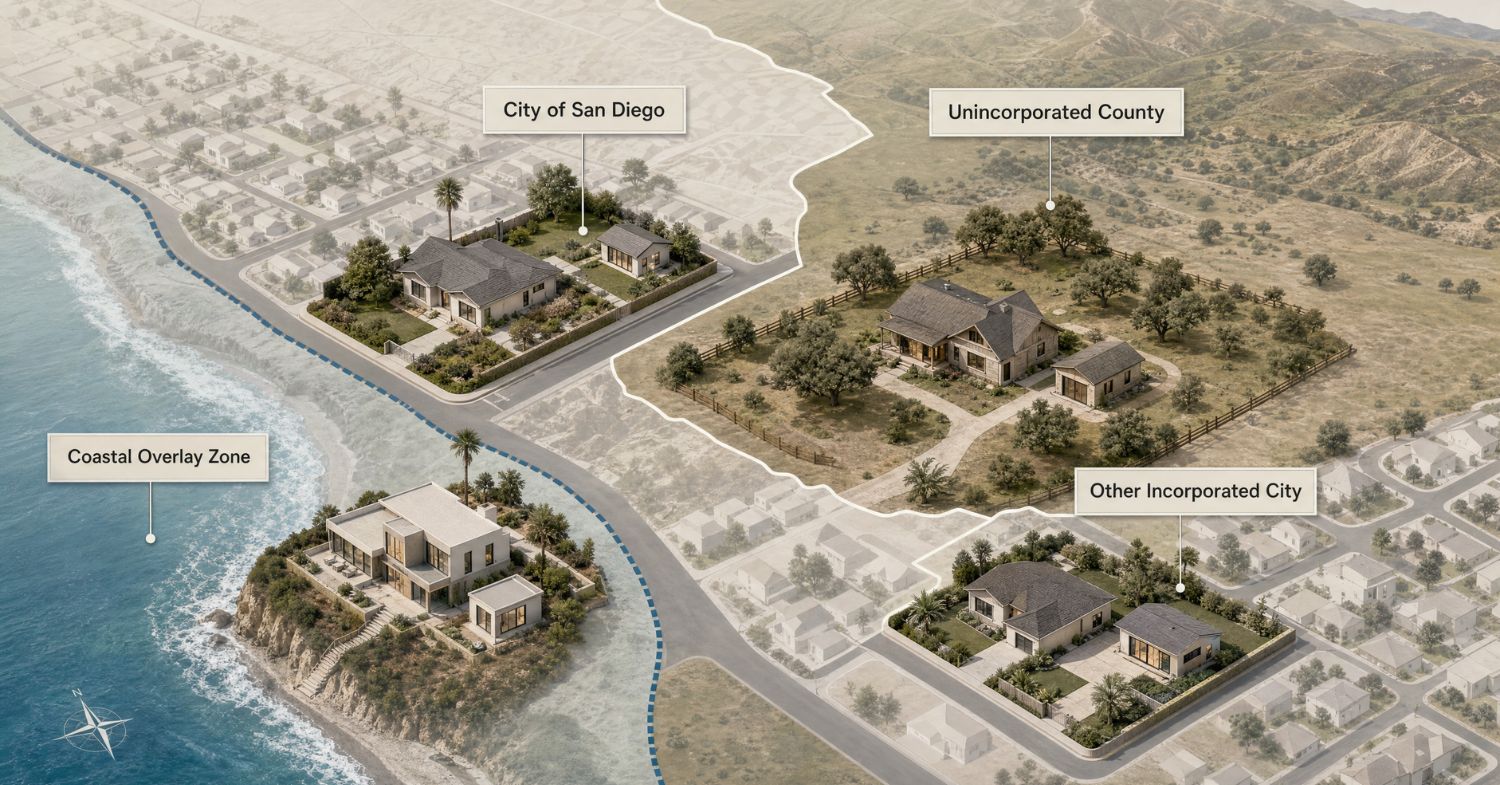
That jurisdiction split is where most homeowners go wrong. A San Diego mailing address does not tell you whose rulebook applies. Neither does a search result, because nearly every guide to ADU regulations in San Diego picks one agency and blurs the other. There is a second trap underneath it: if your property sits in the Coastal Overlay Zone, several of the City’s newer ADU rules do not apply to you at all yet.
This guide separates the rules by jurisdiction, then walks the process of building an ADU from permit through fees, plus the four legal changes that landed in 2026. Whether you plan to construct an ADU in the City or in an unincorporated community, start with the section that matches your parcel.
Key Takeaways
- Jurisdiction comes first. The City of San Diego and the unincorporated County are separate rulebooks with different setbacks, heights, and parking rules.
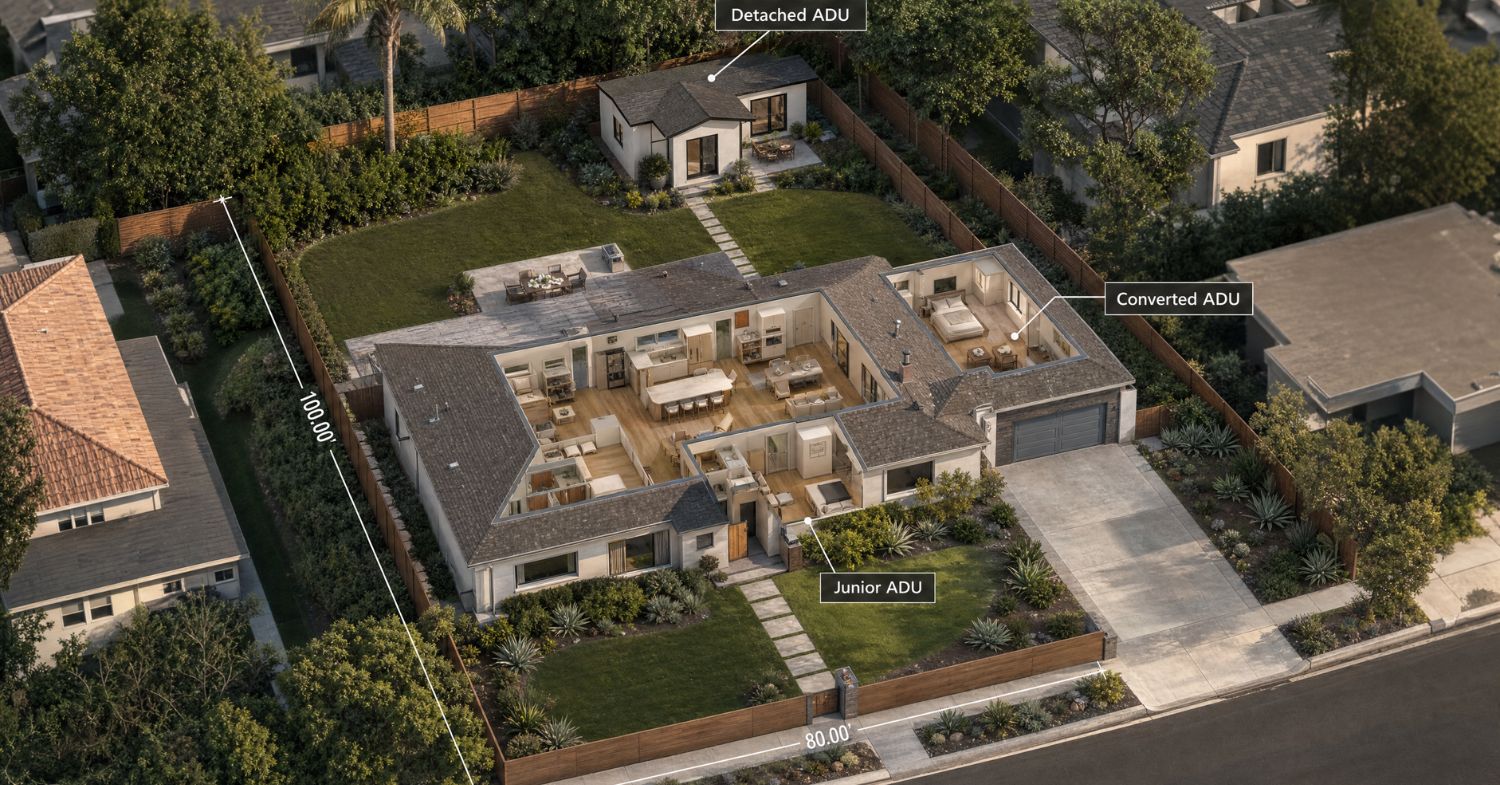
- A City single-family lot can hold four units: the house, one attached or detached ADU, one converted ADU, and one junior ADU.
- City ADUs run from 150 to 1,200 square feet, and conversions of existing structures are exempt from the 1,200-square-foot cap.
- No parking space is required for a standard City ADU outside the Coastal Overlay Zone. The unincorporated County requires one space, with six exceptions.
- Four City ordinances are still not in effect inside the Coastal Overlay Zone because the California Coastal Commission has not certified them.
Rules verified: August 4, 2026, against City of San Diego Information Bulletin 400 (January 2026), the County of San Diego ADU Zoning Ordinance amendment adopted March 4, 2026, and California statutes chaptered in 2025.
Research standard: Every requirement below is sourced to the governing agency or to California statute. Contractor and vendor estimates are not used as evidence of what the code requires.

Which San Diego ADU Regulations and Zoning Requirements Apply to Your Property?
Three questions decide your rulebook, and they must be answered in order: which agency has jurisdiction, which zone the parcel carries, and whether the parcel falls inside the Coastal Overlay Zone. Getting the first question wrong invalidates every answer after it, and roughly 60 percent of the county’s population lives outside City limits.
A “San Diego, CA” mailing address does not mean the City of San Diego governs your property. Three different situations exist:
- City of San Diego. Governed by the San Diego Municipal Code, Chapter 14, Article 1, Division 3 and explained in Information Bulletin 400.
- Unincorporated San Diego County. Places like Ramona, Alpine, Fallbrook, Lakeside, and Valley Center. Governed by the County Zoning Ordinance and administered by County Planning & Development Services.
- Another incorporated city. Chula Vista, Oceanside, Escondido, Carlsbad, El Cajon, La Mesa, and the rest each run their own ADU procedures within the limits state law sets.
Once you know the agency, you need the zone. City property owners can look up a parcel’s base zone and overlays through the City’s Zoning and Parcel Information Portal. That lookup also tells you whether the Coastal Overlay Zone applies, which changes the answers in ways covered further down.
If you are still deciding whether an ADU makes sense at all, the complete San Diego ADU guide compares unit types, timelines, and outcomes. This page is the rulebook.
How Many Accessory Dwelling Units in San Diego Can One Lot Hold?
San Diego’s rules let a City single-dwelling-unit lot hold four units in total: the primary home, one attached or detached ADU, one ADU converted from existing space, and one junior accessory dwelling unit. Multifamily properties can do considerably more, with up to eight detached ADUs permitted on a premises with an existing multi-dwelling structure.
Single-dwelling-unit zones
Per Information Bulletin 400, a single-dwelling-unit zone permits:
- 1 primary dwelling unit
- 1 ADU attached to or detached from the existing or proposed dwelling, so one detached ADU plus one conversion is the common pattern
- 1 ADU converted from existing or proposed space in the dwelling or an existing accessory structure
- 1 junior accessory dwelling unit
That combination, one ADU and one JADU alongside a converted unit, is the maximum most City lots reach. Accessory dwelling units and junior accessory dwelling units are counted separately in the City’s ADU regulations, which is why a lot can carry both. Guest quarters and non-habitable accessory structures are allowed on top of that. The type of ADU you choose determines which size and setback rules apply, so decide whether you want to build an ADU from new construction or convert a garage to an ADU before drawing anything.
Multiple-dwelling-unit zones
| Situation | Maximum ADUs |
|---|---|
| Conversion of existing non-habitable space (storage, boiler rooms, attics, basements, garages) | 25% of the total existing dwelling units, minimum of one |
| New detached ADUs on a premises with an existing multi-dwelling structure | 8, and never more than the number of existing units |
| New detached ADUs on a premises with a proposed multi-dwelling structure | 2 |
| Attached ADUs on a multi-dwelling premises | Not permitted |
Source: City of San Diego Information Bulletin 400, January 2026.
How many ADUs are allowed in San Diego by lot area
Homeowners using the ADU Home Density Bonus Program face a hard cap tied to lot size, counting all ADUs and JADUs on the premises:
| Lot area (square feet) | Maximum ADUs and JADUs |
|---|---|
| 8,000 or less | 4 |
| 8,001 to 10,000 | 5 |
| 10,000 or greater | 6 |
Lot area for this calculation excludes environmentally sensitive lands.
Size Limits and Height Rules for ADUs in San Diego
City of San Diego ADUs range from a minimum of 150 square feet to a maximum of 1,200 square feet of gross floor area. The single most useful exception in the entire code is that conversions escape the cap: an ADU created inside an existing accessory structure or part of the existing home is not subject to the 1,200-square-foot maximum at all.
Size rules for City ADUs:
- Minimum gross floor area: 150 square feet
- Maximum gross floor area: 1,200 square feet
- Conversions of an existing accessory structure or part of the primary residence are exempt from the 1,200-square-foot maximum
- A conversion may add up to 150 square feet beyond the existing envelope, and only to allow for ingress and egress
- Minimum room dimensions from the California Building Standards Code still apply
Floor area ratio gets its own carve-out. An ADU’s floor area counts toward the premises total and is subject to the zone’s floor area ratio, but an ADU of 800 square feet or less may be built in three situations where it would otherwise be blocked: when existing units already exceed the maximum allowable FAR, when the resulting FAR would exceed the maximum, and when a project proposes new units that comply with the maximum FAR. In practice, an 800-square-foot ADU is very difficult to zone out on FAR grounds alone, because the floor area of the ADU is treated separately from the rest of the premises in each of those cases.
Junior ADUs run from 150 to 500 square feet, must sit within an existing or proposed single dwelling unit or an attached garage, and require a kitchen or efficiency kitchen. A JADU’s floor area is excluded from the premises gross floor area entirely, and construction may expand the existing home by up to 150 square feet solely for ingress and egress.
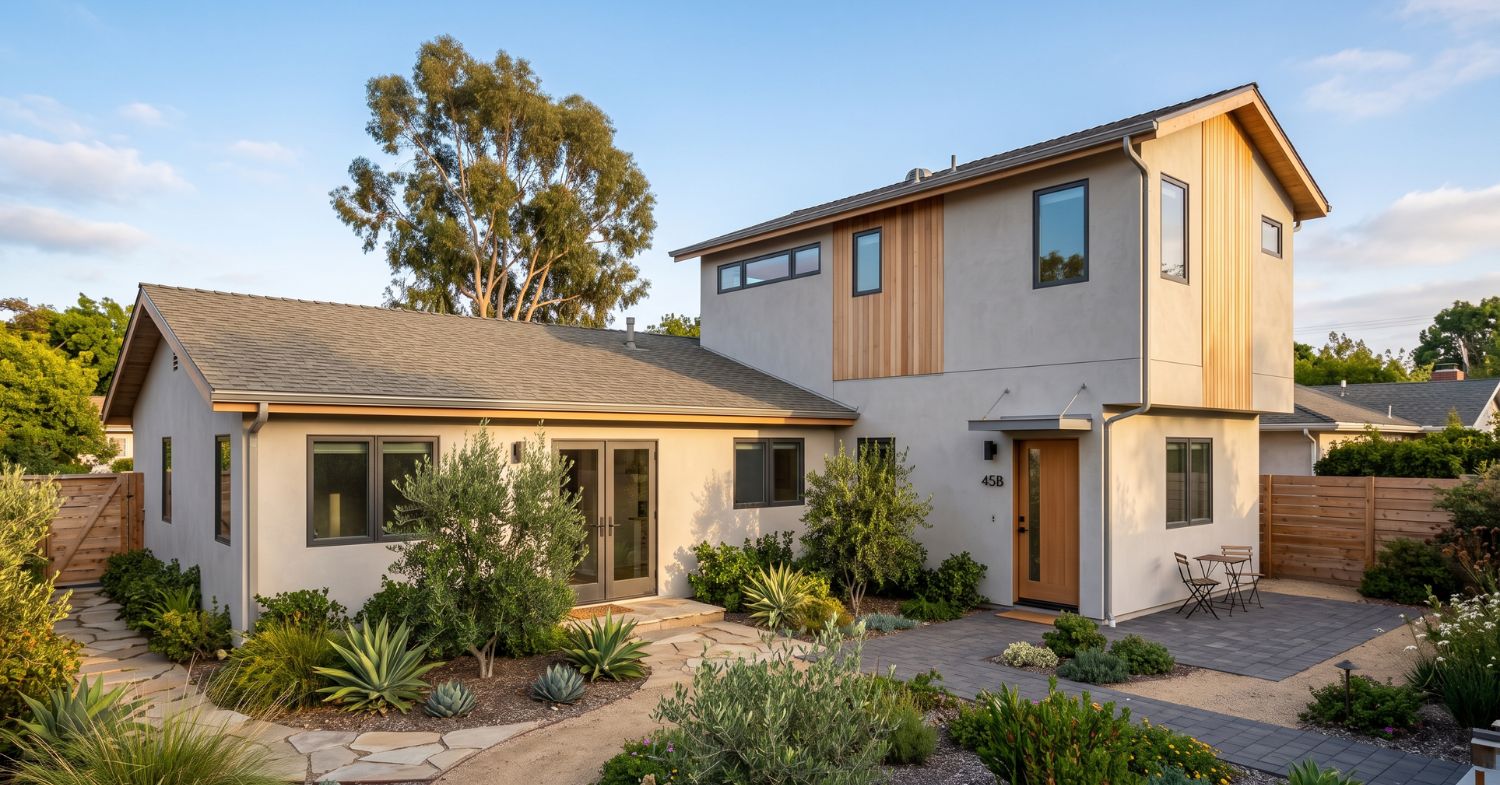
Height is governed by two limits at once. On lots that allow single-dwelling development but not multi-dwelling development, detached ADUs and ADUs attached to an existing accessory structure may not exceed two stories. Every ADU must also comply with the maximum structure height of the underlying base zone and any overlay zone.
ADU Setback Requirements in San Diego: Front, Side, and Rear Yard Setback Rules
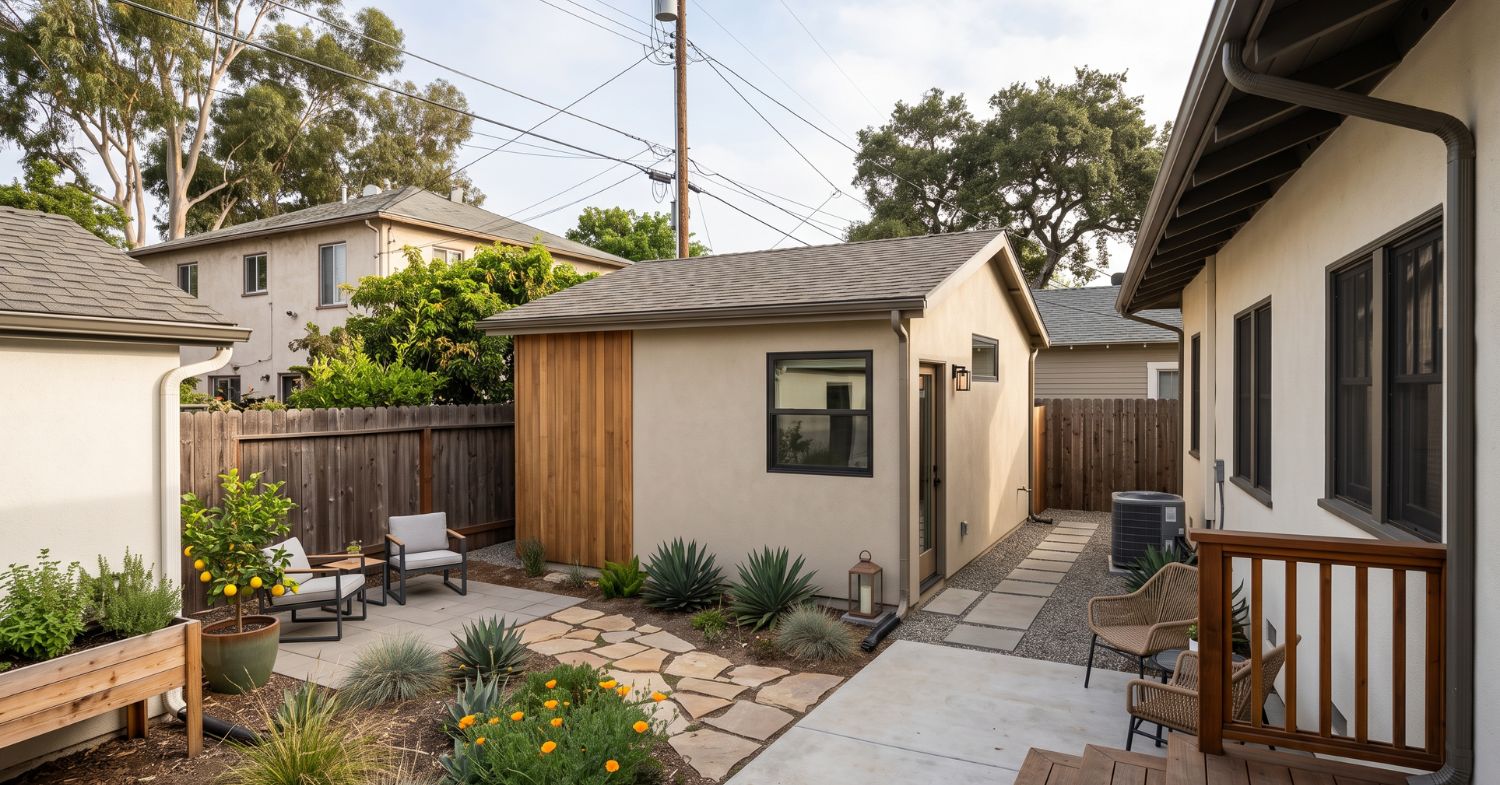
Here is the rule most guides get backwards: in the City of San Diego, a new detached ADU may be built all the way to the side or rear property line. The commonly quoted four-foot setback is a conditional requirement in the City, not the default, and it applies mainly to structures over 16 feet in height.
How City setbacks actually work:
- An existing structure converted to an ADU may keep the setbacks it already has.
- Demolition and reconstruction. A demolished structure rebuilt as an ADU may keep the original setbacks if it is rebuilt in the same location and to the same dimensions.
- Front yard. New ADUs must observe the zone’s front yard setback. One ADU of 800 square feet or less may encroach into it.
- Street side yard. The zone’s street side yard setback or four feet, whichever is less.
- Side and rear yards. An ADU may encroach into the side and rear setbacks, including up to the property line, unless the California Building Standards Code requires otherwise for fire separation distance, opening protection, allowable height, or allowable area.
The conditions that put four feet back on the table:
- The ADU exceeds 16 feet in structure height and the side or rear property line abuts a residentially zoned or exclusively residential premises. Minimum four-foot interior side and rear setbacks apply.
- The premises sits in a Very High Fire Hazard Severity Zone. Four-foot minimum interior side and rear setbacks apply regardless of height.
The Fire Code Official may require greater setbacks to comply with the California Fire Code and International Fire Code, and additional setbacks may apply inside a Brush Management Zone. Exterior staircases, decks, and balconies must conform to the base zone setback rather than the ADU allowance.
Note the practical consequence: building code fire separation requirements, not zoning, are what usually pull an ADU away from the property line. That is a design conversation, not a zoning appeal.
Parking Requirements for ADUs in San Diego
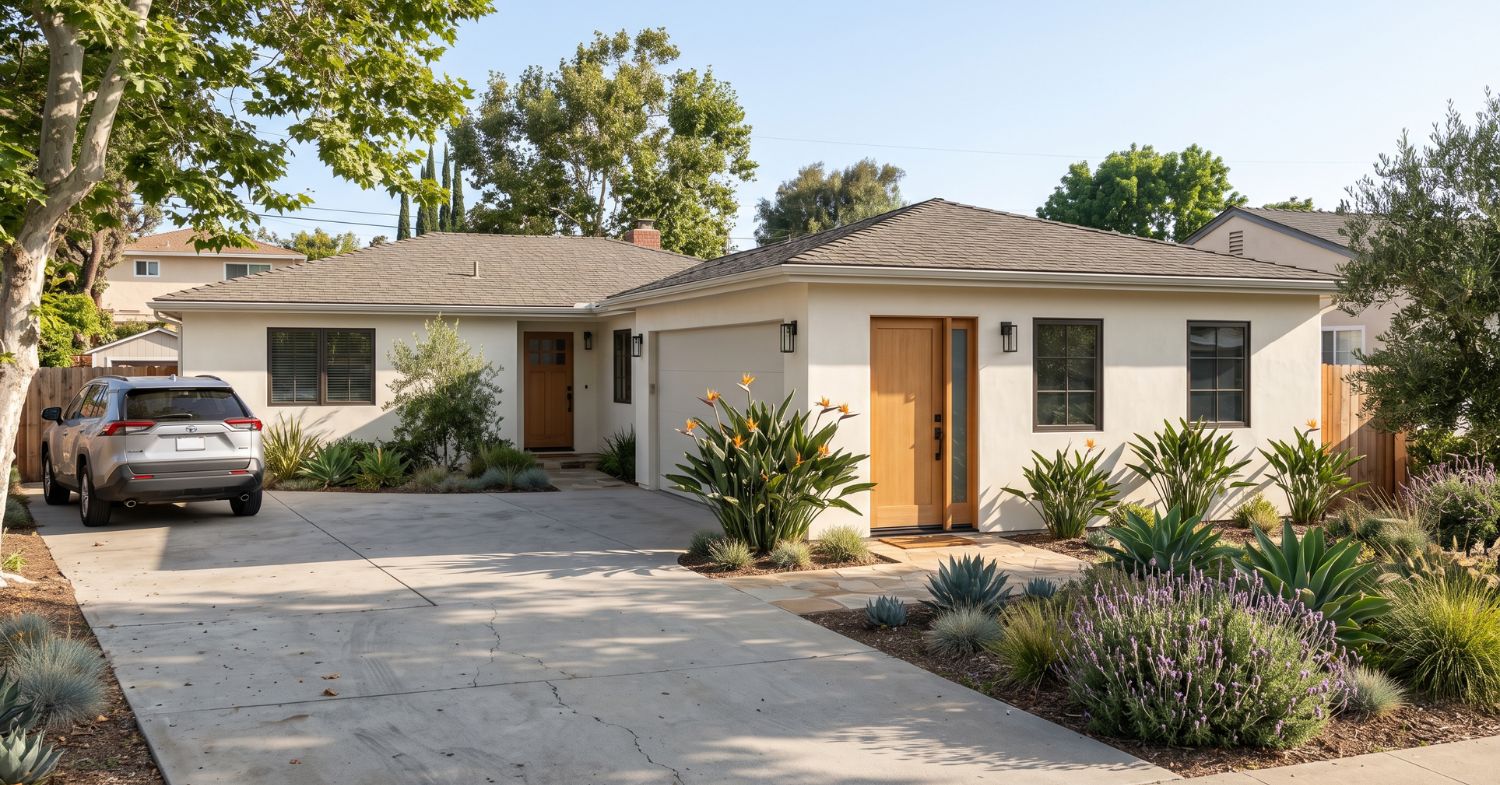
Zero parking spaces are required for a standard ADU in the City of San Diego outside the Coastal Overlay Zone, against 1 space in the unincorporated County. That single difference is one of the largest practical gaps between the two rulebooks, and it means a City homeowner can convert a garage into an ADU without replacing the lost parking.
The City’s single exception applies when a property is in the Coastal Overlay Zone and within the Beach Impact Area of the Parking Impact Overlay Zone and outside a transit priority area. In that narrow case, one off-street space is required unless any of the following apply:
- The ADU is 500 square feet or less
- The premises is in a historical district and is a designated historical resource
- The ADU is attached to the proposed or existing primary dwelling or accessory structure
- The premises is in a residential permit parking district
- A car share vehicle is located within one block of the premises
Garage conversions. Converting or demolishing a garage, carport, or covered parking structure does not require replacement parking, except in that same coastal and beach impact case. Demolishing uncovered spaces never requires replacement. If an ADU causes an existing driveway curb to fall out of compliance with City standards, the driveway must be closed to the satisfaction of the City Engineer.
Junior ADUs require no on-street or off-street parking in the City.
Watch the Bonus Program exception. Parking requirements for ADUs built through the ADU Home Density Bonus Program are different. One off-street space is required for each Affordable ADU and each Bonus ADU located outside a Transit Priority Area. The headline “no parking required in San Diego” does not survive contact with that program.
Coastal Overlay Zone: City of San Diego ADU Rules Not Yet in Effect
If your parcel sits in the Coastal Overlay Zone, you are governed by an older version of San Diego’s ADU rules than the one described almost everywhere else. The California Coastal Commission certified one ordinance on September 12, 2024, and four more remain uncertified as of August 4, 2026, which means those newer regulations are not in effect coastally.
This matters enormously in a city whose coastal overlay reaches into La Jolla, Pacific Beach, Ocean Beach, Point Loma, and Mission Beach.
Certified and in effect: Ordinance O-21439, tied to Housing Action Package 1.0. ADU projects in the Coastal Overlay Zone follow the setback and landscape requirements that package established.
Adopted by the City but not yet effective in the Coastal Overlay Zone, pending Coastal Commission certification of Ordinance Numbers O-21618, O-21758, O-21836, and O-21989:
| Ordinance | What is not yet effective coastally |
|---|---|
| O-21758 (Housing Action Package 2.0) | The accessible ADU home incentive program, and the rule that a JADU may only be built within an existing or proposed single dwelling unit or an attached garage |
| O-21836 (2024 Land Development Code Update) | Street tree requirements based on allowable development area, and the setback allowance letting ADU structures over 16 feet use base zone regulations when those are less than the four-foot ADU minimum |
| O-21989 (2025 ADU and JADU Regulation Amendments) | Adjustments to the ADU Home Density Bonus Program, and alignment with state law |
Source: City of San Diego Information Bulletin 400, editor’s note, January 2026.
Coastal Development Permits
A Coastal Development Permit is required for any ADU or JADU in the Coastal Overlay Zone that is not completely contained in the existing primary structure, that increases habitable area, or that converts non-habitable space.
Since September 7, 2022, ADUs and JADUs proposed in the non-appealable area of the Coastal Overlay Zone have been eligible for a City-issued Coastal Development Permit, provided specific administrative findings confirm the project conforms to the Local Coastal Program. When those findings are satisfied, the permit is issued as a Building Permit under Process One. Creating a JADU in the Coastal Overlay Zone does not categorically require a Coastal Development Permit, and qualifying projects may proceed without one.
Because certification status can change, confirm the current position with Development Services before finalizing coastal designs.
How to Build an ADU in San Diego: Building Permit Process and Requirements
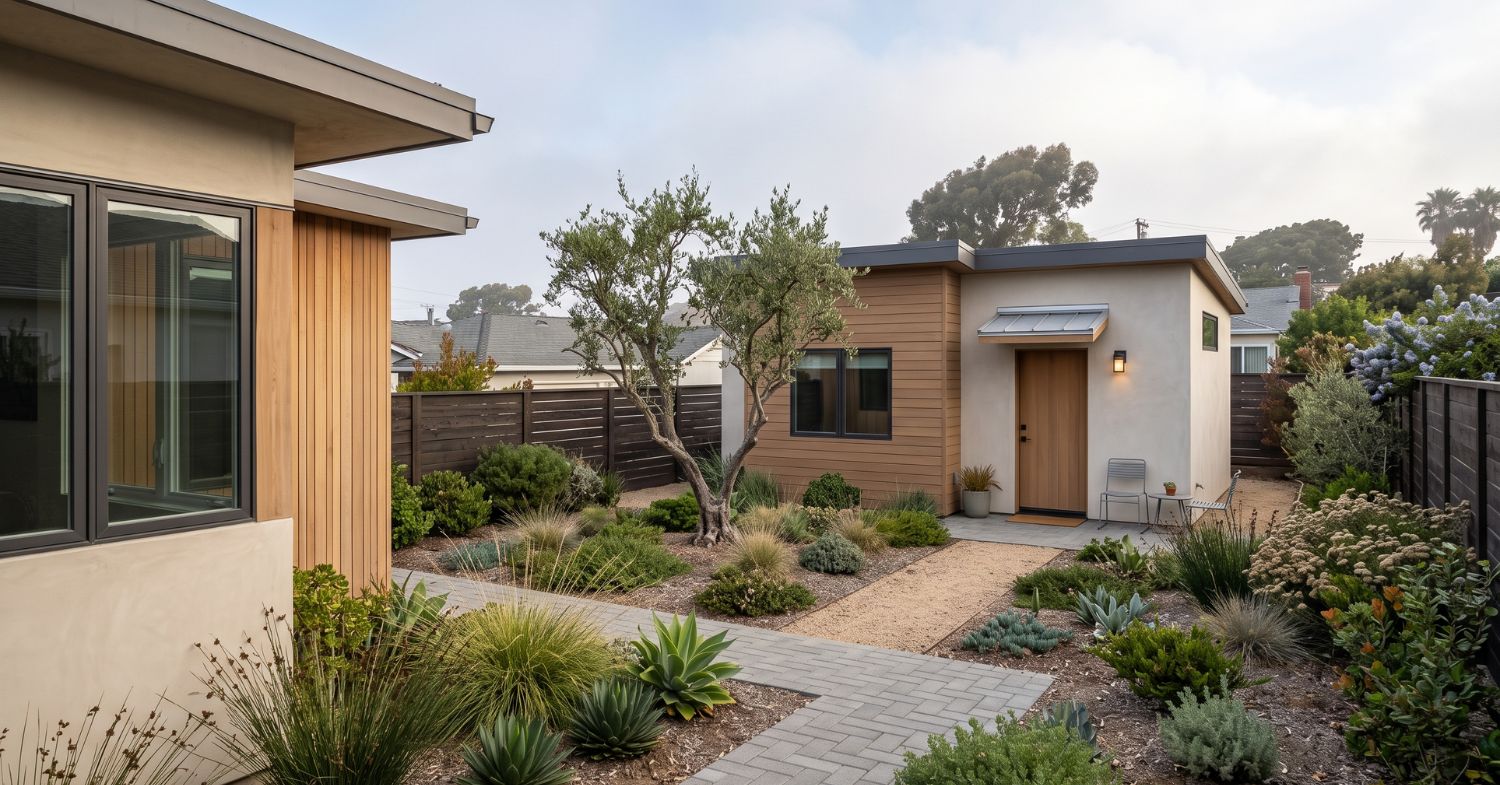
A Building Permit is required to create an ADU or JADU in the City of San Diego, and there are no exemptions. Applications are filed digitally through the City’s online permitting portal, and projects using preapproved plans get a 30-day review instead of the standard timeline.
What you submit
| Category | Required items |
|---|---|
| Plans | Site plan and vicinity map (per Information Bulletin 122), floor plans, roof plans, elevations and sections as applicable, structural plans and details |
| Calculations | Structural and truss calculations as applicable, Title 24 energy calculations |
| Forms | DS-3032 General Application, DS-16 Water Meter Data Card, DS-560 Storm Water Applicability Checklist |
Depending on how many dwelling units the project creates, the City issues either a Combination Building Permit or a Building Permit. Applications are submitted through the City’s online permitting portal.
Preapproved plans and the 30-day track
Under Assembly Bill 1332, applicants may apply using preapproved plans, and those applications are subject to a 30-day review while still complying with the development regulations in the Municipal Code. One detail catches people out: to use a preapproved plan, you must contact the plan’s provider directly to license it for your own ADU. The City publishes the list of available plans but does not license them to you.
Homeowners may also submit their own plans for preapproval so others can license them, processed through the master plan production process. Pre-approved ADU plans shorten review, but they do not change the zoning requirements that apply to your lot.
Review timelines
State law sets the clock. Under Senate Bill 543, chaptered October 10, 2025 and effective January 1, 2026, a permitting agency must provide written notice of whether an application is complete within 15 business days of receiving it, including an itemized list of what is missing. The 60-day approval or denial deadline then runs from the date the agency receives a completed application.
For a realistic view of how permit review fits into the whole schedule, from feasibility through final inspection, see the complete San Diego ADU guide.

How Much Does an ADU Permit Cost in San Diego?
There is no single ADU permit fee in San Diego. The total is assembled from plan check and permit fees plus a set of separate agency charges, and two state exemptions tied to square footage can remove entire categories from your bill. An ADU of 750 square feet or less pays no development impact fees, and a unit under 500 square feet pays no school fees.
| Fee | Applies to | Governing reference |
|---|---|---|
| Plan check and permit fees | All ADUs and JADUs | Information Bulletin 501 |
| School fees | ADUs and JADUs | Information Bulletin 146; exempt under 500 square feet of interior livable space |
| General Plan Maintenance Fee | All ADUs and JADUs since August 9, 2022 | Information Bulletin 501 |
| Development Impact Fees | ADUs | Municipal Code section 142.0640(b)(1); exempt at 750 square feet or less |
| Regional Transportation Congestion Improvement Program | Projects proposing more than one ADU | Information Bulletin 501 |
| Inclusionary Housing | Projects reaching 10 or more total dwelling units, or 5 or more in the Coastal Overlay Zone | Municipal Code Chapter 14, Article 2, Division 13 |
| Community Enhancement Fee | ADU Home Density Bonus Program projects | Municipal Code section 141.0302(d) |
The square footage thresholds deserve real attention during design. Senate Bill 543 provides that a unit with less than 500 square feet of interior livable space is not treated as increasing assessable space for school facility fee purposes, and that no impact fees apply to an ADU of 750 square feet or less of interior livable space, or a JADU of 500 square feet or less. Larger ADUs pay impact fees proportionate to square footage. Crossing 750 square feet is therefore a budget decision, not just a design one.
Current dollar amounts change, so confirm them against the City’s published fee schedule before you budget. For total project cost rather than agency fees alone, see our San Diego ADU cost and financing guide.
Owner Occupancy, Rentals, and Selling an ADU or Junior Accessory Dwelling Unit
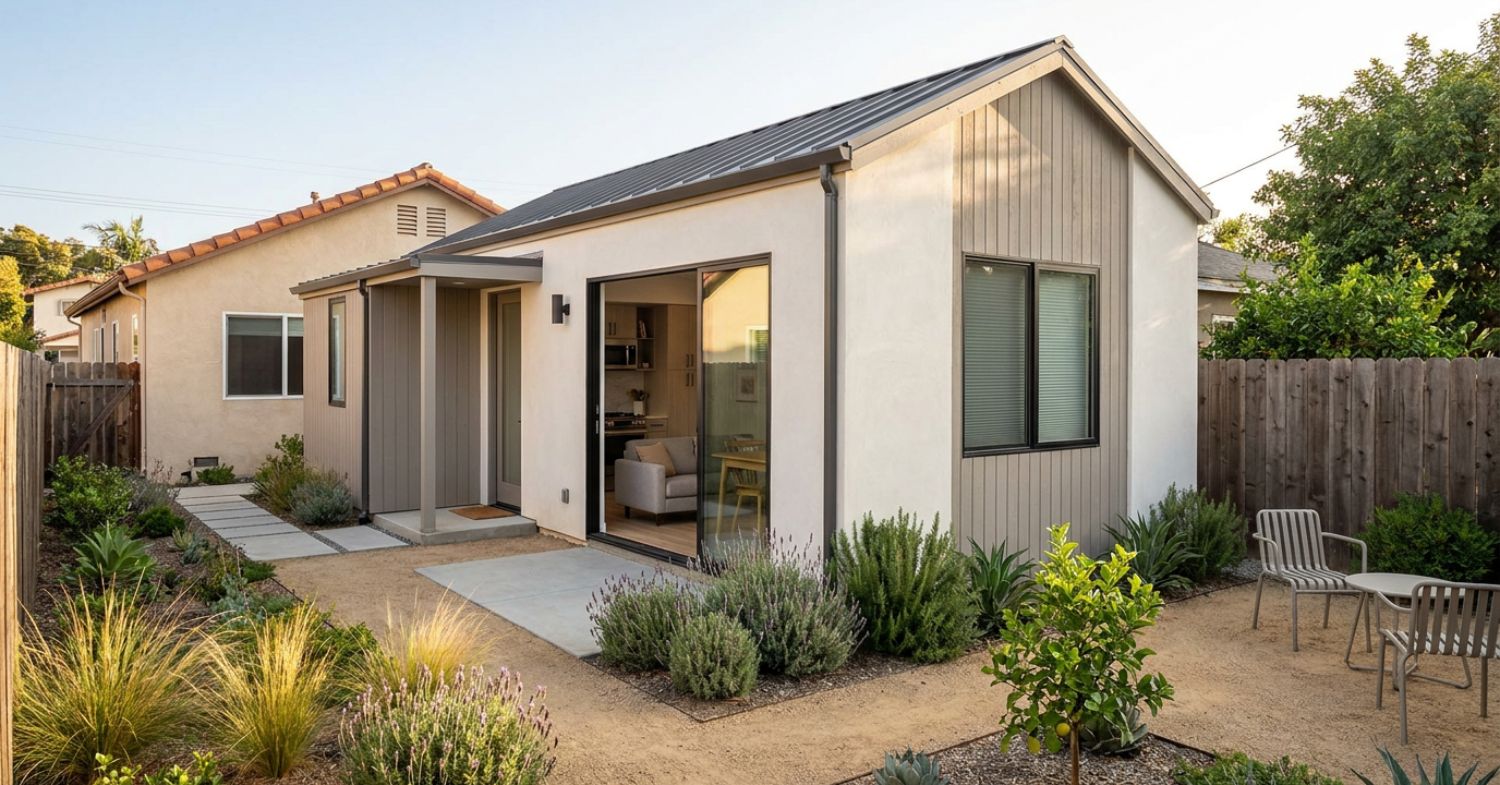
The City of San Diego does not require an ADU owner to live on the property. Junior ADUs are the exception, and 2026 changed that rule: under Assembly Bill 1154, owner occupancy applies to a JADU only when it shares sanitation facilities with the primary dwelling.
Owner occupancy. Information Bulletin 400 states plainly that the property owner is not required to live on site for a standard ADU. For JADUs, the bulletin requires the owner to live in one of the on-site dwelling units, unless the owner is a government agency, land trust, or qualified housing organization. Assembly Bill 1154, Chapter 507 of the Statutes of 2025, narrows that state authorization: a local agency may require owner occupancy in the single-family residence only “if the junior accessory dwelling unit has shared sanitation facilities with the existing structure.” The bill was chaptered October 10, 2025 without an urgency clause, making it effective January 1, 2026. Because the City’s bulletin carries an August 2025 revision date on this point, confirm how Development Services is applying the change to a JADU with independent sanitation.
Rental rules for an ADU or JADU
Rental terms. A City ADU may not be leased for a term shorter than 31 consecutive days, which rules out short-term rental. Information Bulletin 400 states that JADUs are not subject to rental term limitations, while AB 1154 authorizes a requirement that JADU rentals run longer than 30 days. Verify which applies before relying on a shorter JADU tenancy. Before permit issuance, a Junior Unit Agreement is required, confirming that neither unit may be sold separately and that the record owner will reside in the primary dwelling, ADU, or JADU.
For rent levels, cash flow, and what an ADU realistically returns, that belongs to a separate analysis rather than the code.
Selling an ADU separately. California’s Assembly Bill 1033 lets local agencies allow ADUs to be sold separately from the primary residence. The City of San Diego implements it at Municipal Code section 141.0302(f) through condominium subdivision, and the requirements are substantial:
- The subdivision must comply with the Davis-Stirling Common Interest Development Act and the Subdivision Map Act
- Every lienholder must give written consent before a subdivision map or condominium plan is recorded
- The ADU must have final approval of all inspections under its building permit before the condominium plan is recorded
- Utility providers must be notified of the condominium creation and separate conveyance
- For at least 30 days after the ADU condominium is first listed, the owner must offer it through at least two publicly accessible real estate websites with a disclosure that it is being offered to buyers intending to use it as their primary residence, secured by a recorded covenant
Two categories cannot be sold separately for the duration of their deed restriction: ADUs that received financing or assistance from the San Diego Housing Commission, and rental ADUs restricted to very low, low, or moderate income households.
The San Diego ADU Home Density Bonus Program: Affordable ADU Bonus Rules and the San Diego Housing Commission
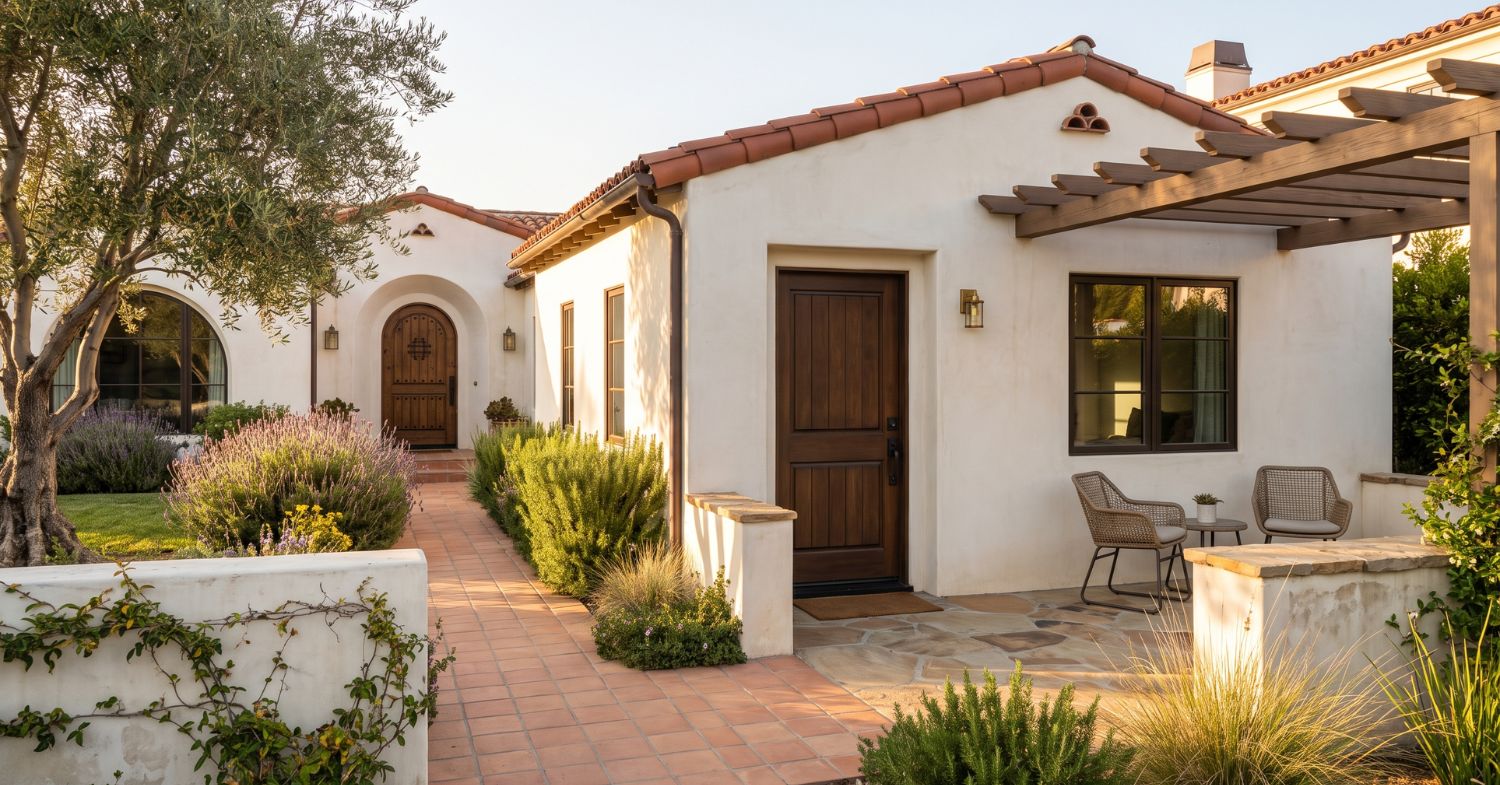
The ADU Home Density Bonus Program trades deed-restricted affordability for additional units, and it carries requirements that standard ADUs do not: sprinklers in every unit, one parking space per bonus and affordable unit outside a Transit Priority Area, and a recorded agreement with the San Diego Housing Commission.
Who qualifies for the ADU Bonus Program
How the bonus works. Inside Sustainable Development Areas, one additional non-deed-restricted bonus ADU is allowed for every qualifying on-site deed-restricted ADU. Outside Sustainable Development Areas, the program permits a maximum of one Bonus ADU and one qualifying deed-restricted ADU. Affordable units must be comparable to the bonus units in bedroom mix and amenities.
Where it is not available. Bonus ADUs are excluded from the RS-1-1, RS-1-2, RS-1-3, RS-1-4, RS-1-8, RS-1-9, RS-1-10, and RS-1-11 base zones unless the premises sits in a High or Highest Resource California Tax Credit Allocation Committee Opportunity Area and is designated residential in the applicable land use plan. Only the qualifying portion of a premises is eligible.
In a Very High Fire Hazard Severity Zone, the lot must front an improved public street with at least two evacuation routes, and bonus ADUs are prohibited where the lot fronts a cul-de-sac or the premises has only one point of ingress or egress.
The added requirements:
- Automatic fire sprinklers in all Affordable and Bonus ADUs, per the California Building Code
- One off-street parking space for each Affordable and Bonus ADU outside a Transit Priority Area
- A minimum of one tree on the premises, plus two trees for every 5,000 square feet of lot area
- An ADU Home Density Bonus Agreement and deed of trust with the San Diego Housing Commission, entered before the first Affordable or Bonus ADU permit issues
- A Community Enhancement Fee based on the gross floor area of the affordable and bonus units, excluding affordable units deed restricted to very low or low income households in a High or Highest Resource Opportunity Area
One additional market-rate accessible ADU is allowed when at least two affordable ADUs are proposed. It must meet Chapter 11A of the California Building Code and include at least one accessible bathroom, one accessible kitchen, and one accessible bedroom on an accessible route. Households planning for an ADU for aging parents should look closely at this provision.
Climate Action Plan Consistency Regulations apply to Bonus Program projects that result in three or more total dwelling units on a premises.
Sprinkler, Solar, and Utility Rules for ADU and JADU Projects
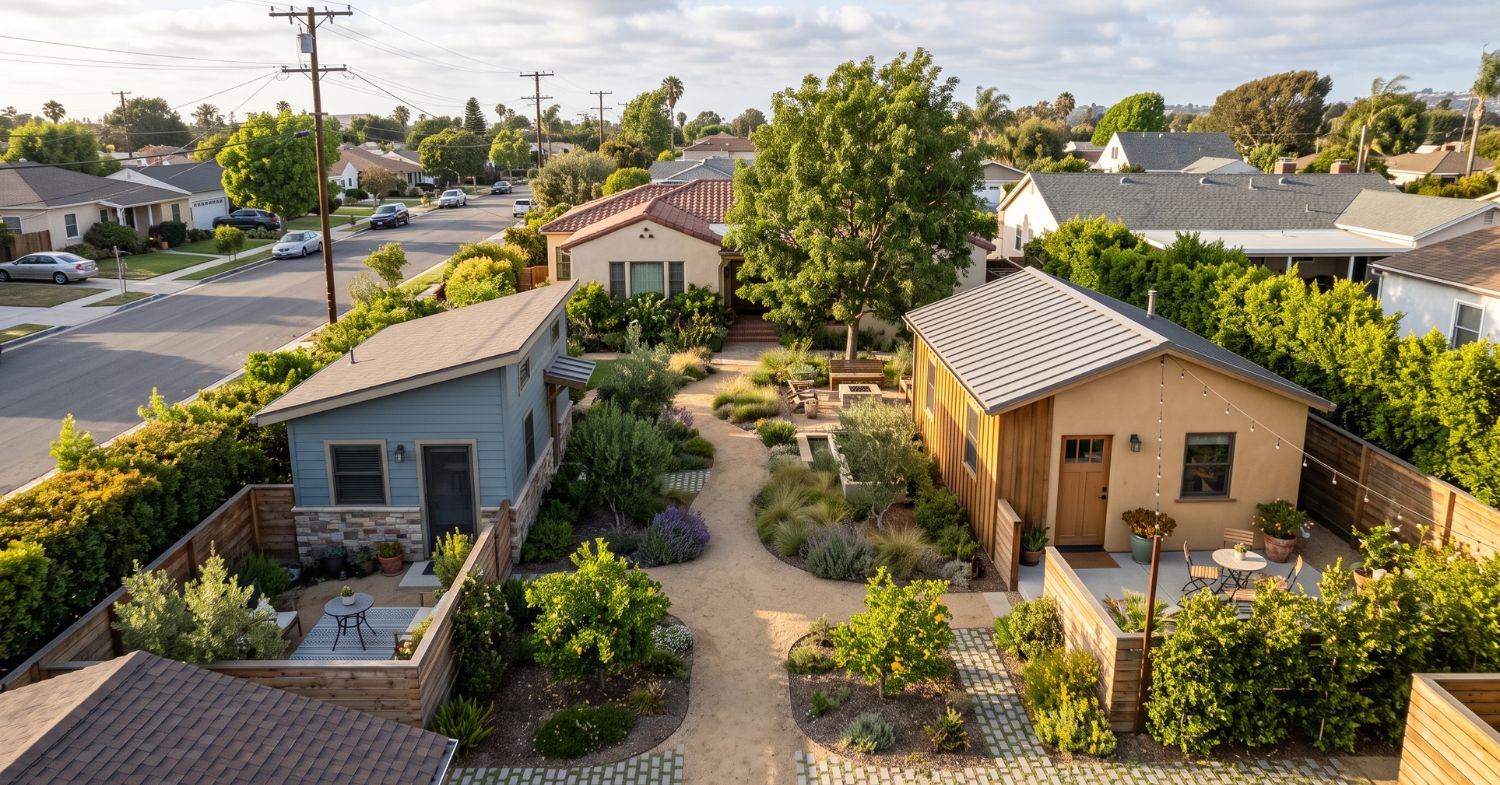
Fire sprinklers follow the primary dwelling, and solar turns on 2 questions: is the unit newly constructed, and is it detached. A new detached ADU of 800 square feet must provide solar panels, while a garage conversion of identical size does not, and junior ADUs are never required to provide solar at all.
Fire sprinklers in the City of San Diego:
- An ADU is not required to have automatic fire sprinklers if the primary dwelling unit does not have them
- An ADU is required to have them if the primary dwelling unit is protected by an automatic sprinkler system
- Constructing a detached ADU does not trigger a sprinkler requirement in the existing primary dwelling or multi-dwelling structure, unless the California Building Standards Code requires it
For JADUs, the same logic applies, with one addition: a JADU may be required to build a fire rated wall where it shares a wall with the single-family dwelling and includes an independent kitchen and independent sanitation facilities.
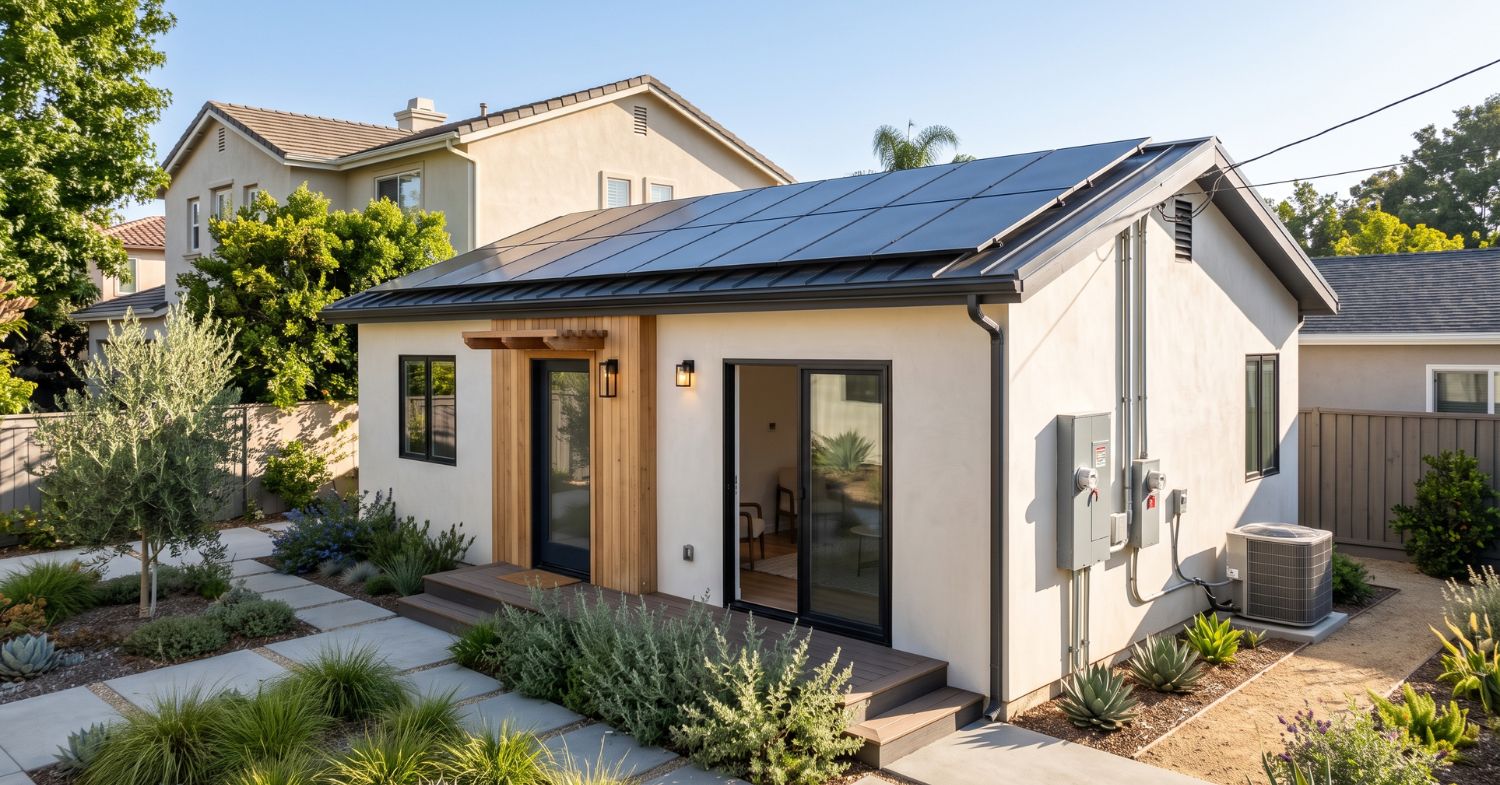
Solar photovoltaic systems. Newly constructed ADUs are subject to the California Energy Code requirement to provide solar panels when the unit is newly constructed, non-manufactured, and detached. Panels may be installed on the ADU or on the primary dwelling. ADUs constructed within existing space, or as additions to existing homes, including detached additions where an existing detached building converts from non-residential to residential space, are not subject to the solar requirement. JADUs are not required to provide a solar photovoltaic system.
Other requirements. ADU development is subject to refuse, organic waste, and recycling storage regulations under Municipal Code section 142.0801, and development exceeding four dwelling units triggers the Mobility Choices Regulations. On sites with an existing multi-dwelling structure, existing landscaping must be preserved or replaced to the extent feasible.
ADU Regulations in San Diego County: Unincorporated Rules and the County ADU Handbook
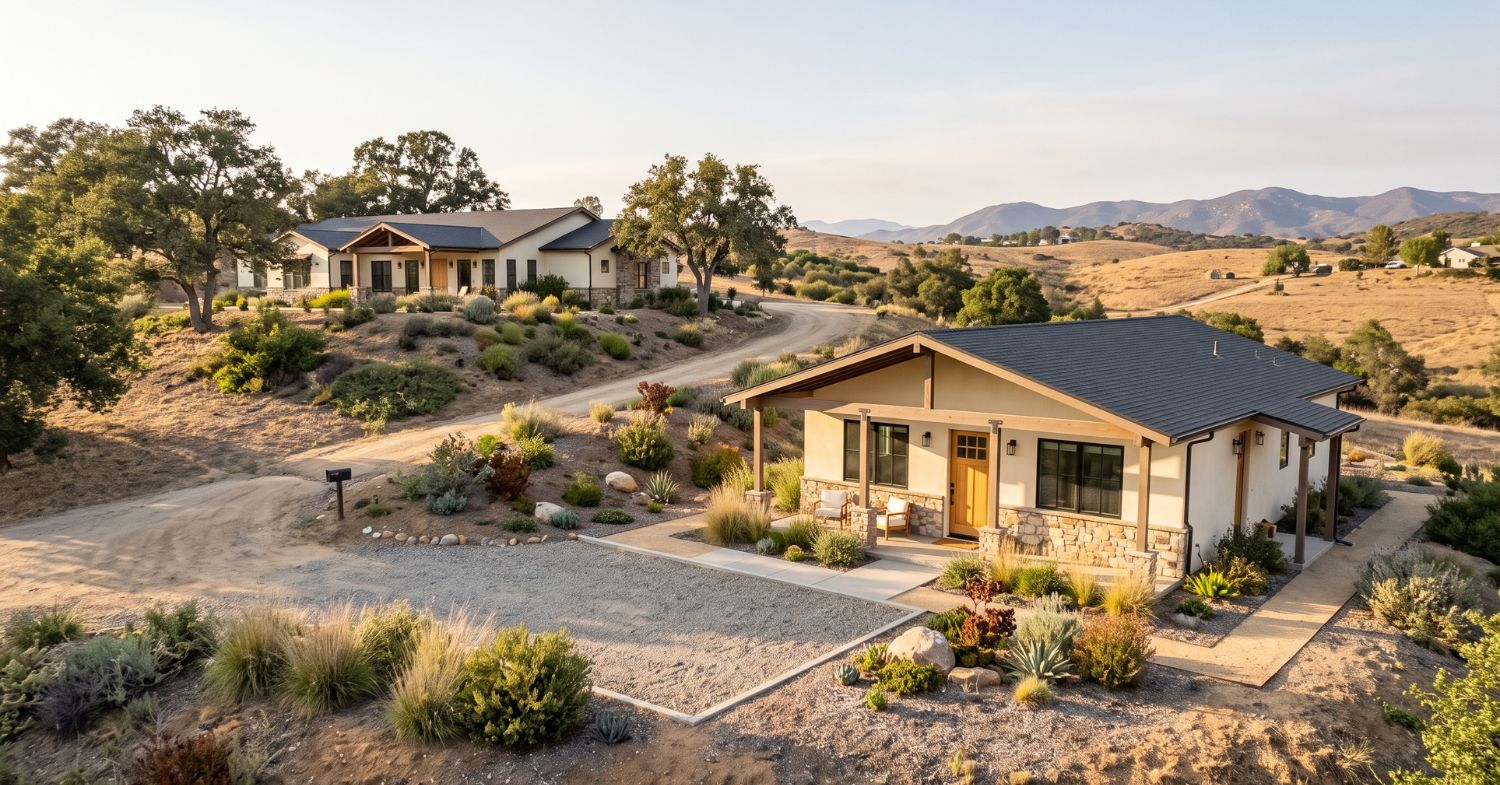
Unincorporated County standards diverge from the City’s in ways that change the design, and the clearest example is parking. The County requires one parking space for an ADU by default, where the City requires none, though six exceptions apply and the first one, being within one-half mile of public transit, removes the requirement for a large share of parcels.
The County Board of Supervisors adopted an amended ADU ordinance on March 4, 2026, reorganizing the ADU and JADU section for alignment with state law and implementing AB 1033. Standards below reflect that amendment at Zoning Ordinance Section 6156.x.
City versus unincorporated County at a glance
| Requirement | City of San Diego | Unincorporated County |
|---|---|---|
| Parking, standard ADU | None required outside the Coastal Overlay Zone and Beach Impact Area | One space required, with six exceptions |
| Maximum detached ADU size | 1,200 square feet; conversions exempt | 1,200 square feet, independent of the primary residence size |
| Maximum attached ADU size | 1,200 square feet | 50% of primary residence floor area up to 1,200 square feet; the 50% limit does not apply up to 850 square feet, or 1,000 square feet with more than one bedroom |
| Side and rear setbacks, new construction | May reach the property line unless building code fire separation applies; 4 feet if over 16 feet and abutting residential | 4 feet minimum |
| Conversion setbacks | Keep the existing structure’s setbacks | None required, except for fire safety, private wells, and installed septic systems |
| Detached ADU height | Two stories on single-dwelling lots, plus base zone maximum | 25 feet |
| Minimum rental term | 31 days | Not less than 30 days |
| Separate sale | Municipal Code section 141.0302(f) | Zoning Ordinance Section 6156.x, effective April 4, 2026 |
The County parking exceptions
A parking space is not required for a County ADU when any of these apply:
- The ADU is within one-half mile of public transit
- The ADU is in an architecturally and historically significant historic district
- The ADU is part of the proposed or existing primary residence or an accessory structure
- On-street parking permits are required but not offered to the ADU occupant
- A car share vehicle is located within one block of the ADU
- The ADU permit application is submitted alongside an application for a new single-family or multifamily dwelling on the same lot
Parking spaces need not be replaced when a garage, carport, or covered parking structure is demolished or converted in conjunction with ADU construction. Where a space is required, it may sit within the setbacks and in an existing driveway as tandem parking.
Two County-only issues
Septic systems. Large parts of the unincorporated County are not on sewer. An ADU on a septic parcel typically requires an On-site Wastewater Treatment System layout application, and the Department of Environmental Health and Quality performs a field inspection. Depending on the load the ADU adds and the capacity of the existing system, an additional or entirely separate septic system may be needed. This is a feasibility gate that has no City equivalent, and it belongs in the budget from day one.
High fire risk setbacks. In High Fire Risk Areas, setbacks may be expanded to between 30 and 100 feet, which can eliminate the buildable area on a parcel that looks generous on paper.
One correction worth making, because outdated guidance still circulates: the County’s trial impact fee waiver ran from January 9, 2019 to January 9, 2024 and has ended. Projects that did not begin before that date do not qualify.
The County’s ADU Handbook remains a useful orientation document, but it carries an April 2024 date and predates the March 2026 amendment. Where the two conflict, the ordinance controls.
New ADU Laws for San Diego Homeowners in 2026
Four changes reshaped San Diego ADU requirements this year: three California statutes that took effect January 1, 2026, and one County ordinance effective April 4, 2026. A fifth change is still in motion, with a County Board of Supervisors hearing tentatively scheduled for August 2026.
| Change | Effect | Status |
|---|---|---|
| AB 1154 (Chapter 507, 2025) | JADU owner occupancy may be required only where the JADU shares sanitation facilities with the existing structure; JADU rentals must run longer than 30 days | Effective January 1, 2026 |
| SB 543 (Chapter 520, 2025) | Written completeness determination within 15 business days; school fee exemption under 500 square feet; impact fee exemption at 750 square feet or less | Effective January 1, 2026 |
| AB 462 | Signed October 10, 2025 as an urgency measure | In effect; confirm scope with Development Services |
| County ADU ordinance | Implements AB 1033, allowing separate sale of ADUs in unincorporated communities through condominium conversion | Adopted March 4, 2026, effective April 4, 2026 |
| County follow-on amendments | Owner-occupancy and homeownership criteria for separate sale | Planning Commission heard June 12, 2026; Board of Supervisors hearing tentatively August 2026 |
The County has published an ADU Condo Guidance and Checklist to help owners determine whether a project qualifies for separate sale. It supplements an application for a Tentative Parcel Map or Tentative Map and does not bypass those processes.
One older change explains a lot of stale information online. Senate Bill 477, effective in 2024, relocated California’s ADU law out of Government Code section 65852.2 and into a new chapter at sections 66310 through 66342. The move was organizational rather than substantive, but any guide still citing section 65852.2 is working from a superseded structure. Current statewide guidance is maintained by the California Department of Housing and Community Development.
Confirm Your Parcel Before You Design
San Diego ADU regulations reward homeowners who work in the right order. Establish the jurisdiction, pull the zone and overlays, check whether the Coastal Overlay Zone applies, and only then start designing. Reversing that order is how projects lose months.
Three conditions change feasibility more often than anything else: a Coastal Overlay Zone designation that freezes newer rules in place, a Very High Fire Hazard Severity Zone that reinstates setbacks and can restrict bonus units, and a septic parcel in the unincorporated County where wastewater capacity governs what you can add.
These rules exist to help San Diego homeowners add housing, but the City’s ADU code rewards anyone who checks the parcel first. This guide describes the rules. It cannot tell you what your specific parcel allows, because that depends on the zone, the overlays, the existing structures, utility capacity, and site conditions. A parcel-specific feasibility review answers those questions before you spend money on drawings. Lars Remodeling & Design offers San Diego ADU feasibility and design-build services for homeowners who want that confirmation first.