Kitchen Remodel Return on Investment: 6 Updates Before Selling
01.
- Share this article
-

-

-

-

-

-

A kitchen remodel can add value before a sale, but the kitchen remodel return on investment is usually strongest when the scope stays small. In the 2025 Cost vs. Value Report, a minor midrange kitchen remodel recouped 112.9% nationally. An upscale major remodel recouped 35.7% (Journal of Light Construction, 2025 Cost vs. Value Report).
That doesn’t mean every seller should remodel. How much value a kitchen remodel adds to your home depends on condition, comparable homes, the sale timeline, and what buyers notice. Before setting a scope, review current San Diego kitchen remodeling costs and ask a local real estate agent how your kitchen compares with competing listings.
Key Takeaways
- A 2025 minor kitchen remodel recouped 112.9% nationally and 129.1% in the Pacific region.
- Cost recouped is not the same as guaranteed profit.
- Repair and condition come before decorative upgrades.
- Keep a sound layout when resale is the main goal.
- Selling as-is can be the right financial choice.
What Is the Average ROI, and How Much Value Does a Kitchen Remodel Add?
In 2025, modeled cost recouped for a minor midrange kitchen remodel was 112.9% nationally and 129.1% in the Pacific region. Major projects recovered far less: 50.9% nationally for a midrange remodel and 35.7% for an upscale remodel (Journal of Light Construction, 2025 Cost vs. Value Report).
Those percentages describe cost recouped, even though many articles call them ROI. The distinction matters:
- Cost recouped equals estimated resale value divided by job cost, multiplied by 100.
- Financial ROI equals estimated resale value minus job cost, divided by job cost, multiplied by 100.
Using the national minor-remodel estimates, 112.9% cost recouped translates to a modeled 12.9% return after subtracting the project cost. The average ROI for a minor kitchen remodel can still vary by local market. The report compares average costs with values estimated by real estate professionals across 119 U.S. markets.
| 2025 kitchen project | National cost | National resale value | National cost recouped | Pacific cost | Pacific resale value | Pacific cost recouped |
|---|---|---|---|---|---|---|
| Minor, midrange | $28,458 | $32,141 | 112.9% | $29,728 | $38,384 | 129.1% |
| Major, midrange | $82,793 | $42,130 | 50.9% | $86,480 | $49,467 | 57.2% |
| Major, upscale | $164,104 | $58,561 | 35.7% | $171,950 | $66,778 | 38.8% |
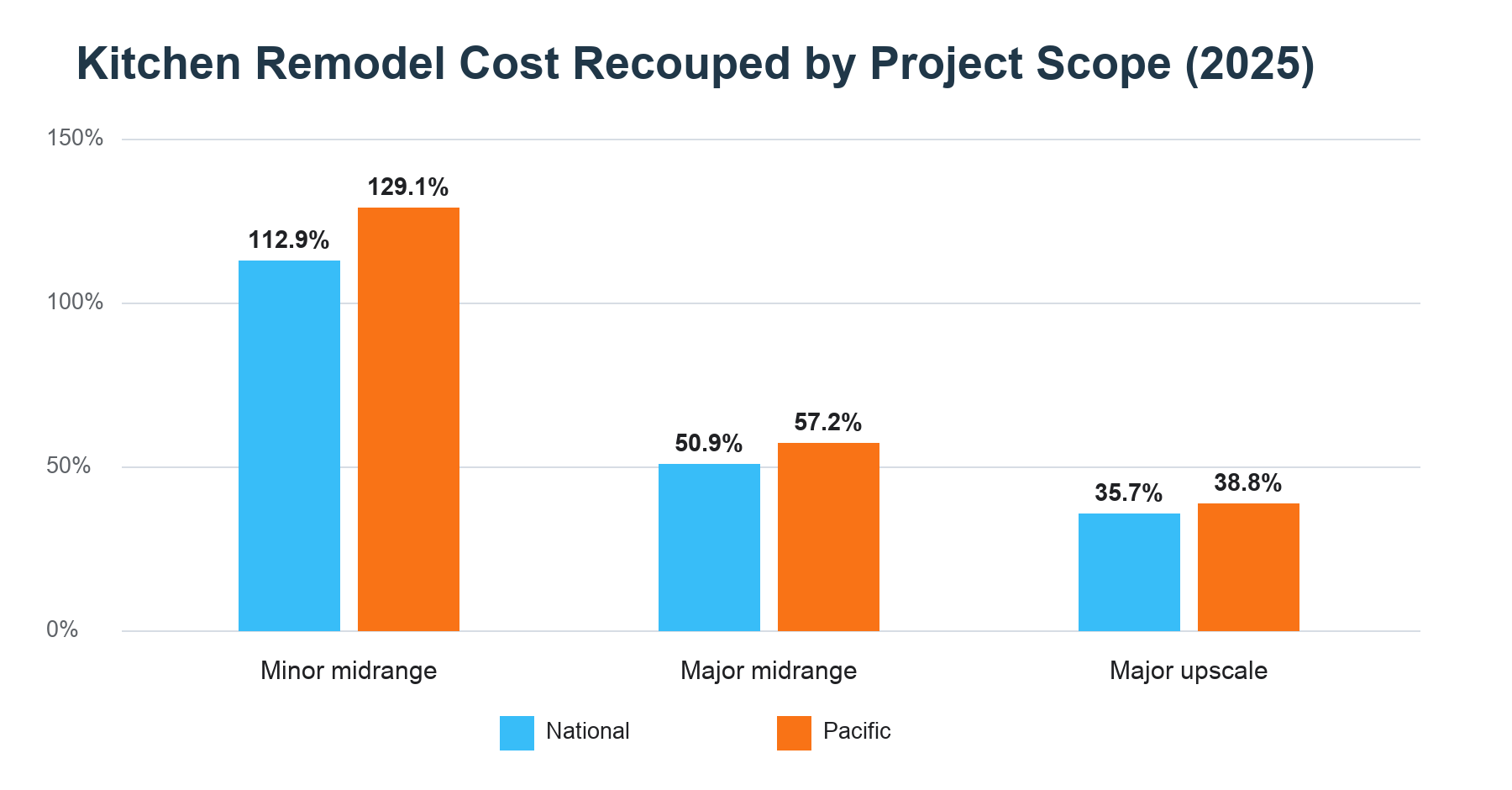
Source: Journal of Light Construction, 2025 Cost vs. Value Report. Values are modeled estimates, not a guarantee for an individual home.
The percentage gap is more useful than any single dollar figure. A high ROI kitchen remodel is usually a targeted refresh that controls cost while improving condition. A major renovation is a larger investment with more layout work, labor, and personal selections that the next owner may not value at the same price.
Should You Remodel Your Kitchen Before Selling?
In 2025, 30% of Realtors recommended a kitchen upgrade before sellers listed, while 48% reported increased buyer demand for kitchen upgrades during the prior two years (NAR and NARI, 2025 Remodeling Impact Report). That supports a conditional answer, not an automatic remodel.
If you’re planning on selling, start with nearby comparable sales. Ask an agent whether home buyers in your price range expect an updated kitchen, tolerate a dated kitchen, or plan to update their kitchen after closing. Then place the property in one of three lanes.
| Choose | When it fits | Sensible next step |
|---|---|---|
| Sell as-is | The kitchen is safe, functional, and similar to nearby listings | Deep clean, declutter, and repair clear defects |
| Targeted refresh | The layout works, but visible wear or dated surfaces weaken the room | Refresh cabinets, fixtures, lighting, paint, or selected surfaces |
| Major remodel | The kitchen has serious functional or structural problems, or you will use it for years before selling | Complete design, permit, schedule, and budget planning before demolition |
The 2026 Houzz Kitchen Trends Study found that 25% of renovating homeowners named improved resale value as a project trigger. Yet median spending was $20,000 for minor projects and $55,000 for major ones (Houzz Research, 2026 U.S. Houzz Kitchen Trends Study). A seller should not fund a full remodel without evidence that the market will reward the added scope or help the home sell faster.
Lars project note: In a completed Vista kitchen remodel, the original room was tucked away from adjacent living areas and did not fit an enthusiastic cook’s six-foot-five frame. Lars changed the circulation, enlarged the island, and added a walk-in pantry because everyday function called for a complete redesign. That is a different decision from refreshing a sound kitchen for an imminent sale: the problem, not a trend checklist, determined the scope.
1. Repair Kitchen Problems Before Cosmetic Upgrades
In 2025, 46% of buyers were less willing to compromise on a home’s condition, according to the NAR and NARI Remodeling Impact Report (NAR and NARI, 2025 Remodeling Impact Report). Fix leaks, unsafe wiring, failed ventilation, damaged doors, and broken appliances before buying decorative finishes.
Start with anything a buyer can see, smell, hear, or discover during an inspection. A dripping faucet, loose outlet, noisy dishwasher, damaged range hood, or swollen cabinet panel creates doubt about the parts of the home that aren’t visible. Paint cannot solve that problem.
Prioritize these checks:
- Active or past water leaks at the sink, dishwasher, refrigerator, and exterior walls.
- GFCI outlets, damaged switches, loose receptacles, and nonworking lights.
- Range-hood operation, exterior venting, and visible grease buildup.
- Cabinet doors, windows, flooring transitions, and appliance clearances.
- Broken seals, cracked surfaces, and unfinished repairs.
Turn that checklist into a labeled prelisting record. During the walk-through, photograph each defect and classify its urgency: safety, moisture, operation, finish, or presentation. Note shutoff accessibility; supply-line corrosion; trap drips; disposal noise; refrigerator clearance; door-gasket tears; burner ignition; oven temperature; hood capture; duct termination; receptacle looseness; GFCI response; switch wear; lamp color; window locks; sash movement; glazing cracks; floor bounce; grout loss; transition height; toe-kick swelling; shelf sag; hinge alignment; drawer-slide drag; countertop burns; seam separation; caulk gaps; backsplash chips; wall stains; ceiling discoloration; baseboard damage; and persistent odors.
This inventory separates a service call from carpentry, tile, electrical, plumbing, ventilation, or floor work. It also helps an agent distinguish a disclosure concern from a photographic distraction. Keep receipts, model numbers, warranties, manuals, permit cards, inspection signoffs, finish samples, paint formulas, and trade contacts together for disclosure and handoff. Store before-and-after photographs in a dated folder so future buyers can understand repaired areas and retained equipment. Archive serials, warranties, permits, and invoices. Record batch codes, serial identifiers, installer licenses, and inspection dates.
Price the items that affect safe use, inspection confidence, reliability, or market presentation. Reserve bowls, runners, artwork, stools, greenery, cookware, towels, and countertop accessories for staging; these reversible props can change the listing photograph without extending construction.
As of July 2026, San Diego permit requirements depend on the work. The City says qualifying kitchen remodels can use a No-Plan Building Permit. Minor plumbing, electrical, and mechanical work may use a Simple MEP permit. Historic properties need added review (City of San Diego, Permits FAQs). Verify the exact scope before work begins.
2. Should Homeowners Refresh Cabinetry or Remodel Cabinets?
In 2025, the highest-recovery kitchen scope left the existing cabinet boxes and layout in place. It replaced fronts, hardware, counters, sink, faucet, flooring, appliances, and paint (Journal of Light Construction, Minor Kitchen Remodel Midrange). Sound cabinet boxes usually favor repair, refinishing, or refacing before replacement.
Open every door and drawer before deciding. Cabinet boxes that are square, dry, and secure can support new fronts and hardware. Repair failed slides and hinges. Replace damaged shelves. Add organizers only where the kitchen space is clearly weak.
In the 2026 Houzz study, pantry cabinets were the most common built-in kitchen feature, chosen by 47% of renovators (Houzz Research, 2026 U.S. Houzz Kitchen Trends Study). For resale, storage should solve an obvious problem. A new kitchen island or pantry should not force wall, plumbing, or appliance changes.
Replace cabinet boxes when they have water damage, structural failure, poor clearances, or a layout defect that materially limits use. Otherwise, keeping them can protect both the budget and the sale timeline. For a broader allocation strategy, compare where to save and splurge in a kitchen remodel.
3. Which Countertops and Backsplash Upgrades Add the Most Home Value?
In the NKBA’s 2026 Kitchen Trends Report, 96% of surveyed industry professionals identified neutral colors as popular, and 72% named transitional or timeless kitchens as a leading style (NKBA, 2026 Kitchen Trends Report). For resale, durable and quiet surfaces usually reach more buyers than highly personal selections.
Install new countertops when cracks, burns, swollen seams, or deep wear pull attention from the room. If the surface is sound, professional repair or cleaning may be enough. The goal is not to install a high-end material. It is to improve value and appeal without making the remaining kitchen look mismatched.
Apply the same test to the backsplash. A simple field tile or restrained solid surface can brighten the room. A loud pattern can narrow buyer appeal. Coordinate counters with the existing cabinets and flooring before ordering anything.
No credible source assigns a reliable standalone ROI to quartz, quartzite, granite, or laminate. Project-level studies measure a whole scope. Choose the material for condition, durability, maintenance, and fit, not a promised percentage return.
4. How Do Lighting, Fixture, and Faucet Updates Add Value?
In the NKBA’s 2026 report, professionals ranked natural lighting at 95%, quality lighting at 93%, and task lighting at 92% as important design considerations. Under-cabinet lighting reached 82% (NKBA, 2026 Kitchen Trends Report). Better light can improve daily use and listing photography without changing the footprint.
Begin with function. Replace failed lamps, damaged fixtures, corroded faucets, leaks, and sinks with chips or permanent stains. Match new finishes to the hardware that will remain. One coordinated change usually looks more deliberate than several unrelated upgrades.
Layer lighting instead of relying on one decorative fixture. General light supports the heart of the home. Task lighting serves counters and the sink. Under-cabinet lighting reduces shadows. Natural light should remain unobstructed where practical.
Avoid opening walls or moving plumbing solely to install a fashionable fixture. Electrical and plumbing changes can affect permits, patching, tile, and scheduling. If the kitchen already functions, improve the fixture where it is.
5. When Should You Buy New Appliances for a Kitchen Renovation?
As of July 2026, ENERGY STAR criteria require qualifying refrigerators of at least 7.75 cubic feet to use 10% less measured energy than federal minimum standards (ENERGY STAR, Refrigerators and Freezers Key Product Criteria). Replace appliances for poor condition, unreliable operation, damage, or a visibly mismatched set, not because every seller needs a luxury package.
Clean and test each appliance first. Confirm that doors seal, burners work, the oven heats, the hood vents, and the dishwasher completes a cycle without leaks. A functioning older appliance may be less concerning than a new model that looks out of place or creates an installation problem.
For dishwashers, July 2026 ENERGY STAR criteria cap standard models at 240 kWh per year and 3.2 gallons per cycle (ENERGY STAR, Dishwashers Key Product Criteria). Those numbers support an efficiency claim, but they do not prove a resale premium.
When replacement is justified, favor reliable midrange models with consistent finishes and correct dimensions. Avoid built-in luxury appliances unless comparable homes in the same market clearly support them. Appliance changes can also trigger cabinet, electrical, gas, countertop, or flooring work.
6. Should You Replace the Floor in a Kitchen Makeover?
In the 2025 NAR and NARI report, 27% of remodeling consumers said worn surfaces, finishes, or materials were the main reason for their project (NAR and NARI, 2025 Remodeling Impact Report). Repair, refinish, or professionally clean flooring before assuming it needs replacement.
Look for trip hazards, water damage, cracked tile, loose boards, failed transitions, and permanent staining. Small repairs can remove an objection without creating a new material boundary. If replacement is necessary, connect the kitchen visually with nearby spaces and select a durable finish that suits the home’s price range.
Paint is the last unifying step. Patch damaged walls, correct moisture issues, and test colors against cabinets, counters, flooring, and natural light. The NKBA’s 96% neutral-color finding supports broad appeal, but neutral does not mean every kitchen must be white.
Finish work should make the existing pieces feel intentional. It should not turn an old kitchen into a chain reaction where one new surface makes every adjacent material look overdue for replacement.
Which Kitchen Upgrades Offer the Best Return on Investment?
In the 2025 Cost vs. Value model, an upscale major kitchen remodel recouped 35.7% nationally, compared with 112.9% for a minor midrange project (Journal of Light Construction, 2025 Cost vs. Value Report). Complexity, cost, and personal selections can rise faster than estimated resale value.
The best return usually comes from repairs and restrained upgrades to a kitchen, not the longest list of changes. Avoid these scopes unless local comparable homes and the kitchen’s condition provide a strong reason:
- Moving walls, plumbing, or work zones when the layout already functions.
- Replacing sound cabinet boxes instead of refreshing fronts and hardware.
- Buying luxury appliances only for a near-term sale.
- Installing highly personal colors, patterns, or other narrow design choices.
- Expanding the scope because one new finish exposes wear elsewhere.
- Starting construction without enough time for design, permitting, ordering, and inspections.
The Journal of Light Construction’s 2025 key-trends analysis calls the minor kitchen remodel a modest facelift and reports that more complex projects produce lower percentage recovery at sale (Journal of Light Construction, 2025 Cost vs. Value Report: Key Trends). A functional kitchen can justify a modest update. A full remodel is harder to justify as a short-term seller investment.
For comparison with roofing, doors, bathrooms, and other projects, review 2025 remodeling cost versus value. If a major kitchen is still appropriate, understand the home remodel design process before setting a listing date.
How Do You Maximize the ROI of a Kitchen Remodel Before Selling?
A pre-sale home improvement should solve a market problem, not create a dream kitchen for an owner who will soon leave. Start with condition and comparable listings. Repair defects first. Then choose a focused, that makes the kitchen clean, functional, cohesive, and appropriate for its price range.
If the property is competitive as-is, keep the money. If a refresh will remove clear buyer objections, define it carefully. If serious problems make a larger project necessary, plan the design, permits, materials, and sale timeline as one decision.
Planning to sell a San Diego home and unsure which path fits? Review how Lars Remodeling handles kitchen remodeling in San Diego, explore the Vista kitchen remodel case study, or schedule a consultation after speaking with your real estate professional.